

Contents UAE Data Protection Law Overview Who Must Comply with UAE PDPL Key Obligations Under UAE Data Protection Law Data Subject Rights in UAE Data Breach Notification Requirements UAE PDPL vs GDPR vs DIFC Data…
Contents
UAE Data Protection Law Overview
Who Must Comply with UAE PDPL
Key Obligations Under UAE Data Protection Law
Data Subject Rights in UAE
Data Breach Notification Requirements
UAE PDPL vs GDPR vs DIFC Data Protection
Penalties for Non-Compliance with UAE Data Protection Laws
How Dubai South Business Hub Free Zone Helps
In 2026, Federal Decree-Law No. 45 of 2021 carries penalties of up to AED 5,000,000 per violation for data protection breaches in the UAE (UAE Data Office, 2026). Over 60% of UAE-registered businesses had not completed a formal PDPL compliance review by Q1 2026 (UAE Data Office, 2026). The UAE processes personal data for over 10 million residents and 3.5 million registered businesses, making privacy law UAE frameworks a top regulatory priority (TDRA, 2026). Data protection laws UAE businesses must follow are active, enforced, and expanding, and the cost of ignoring them is not theoretical.
This guide explains exactly what data protection laws UAE businesses must follow, who is covered under the PDPL, what obligations apply, and how to build a compliant data framework before regulators come knocking. If you're also managing your broader compliance schedule, the company compliance calendar UAE is a practical starting point alongside this guide.
UAE Data Protection Law Overview
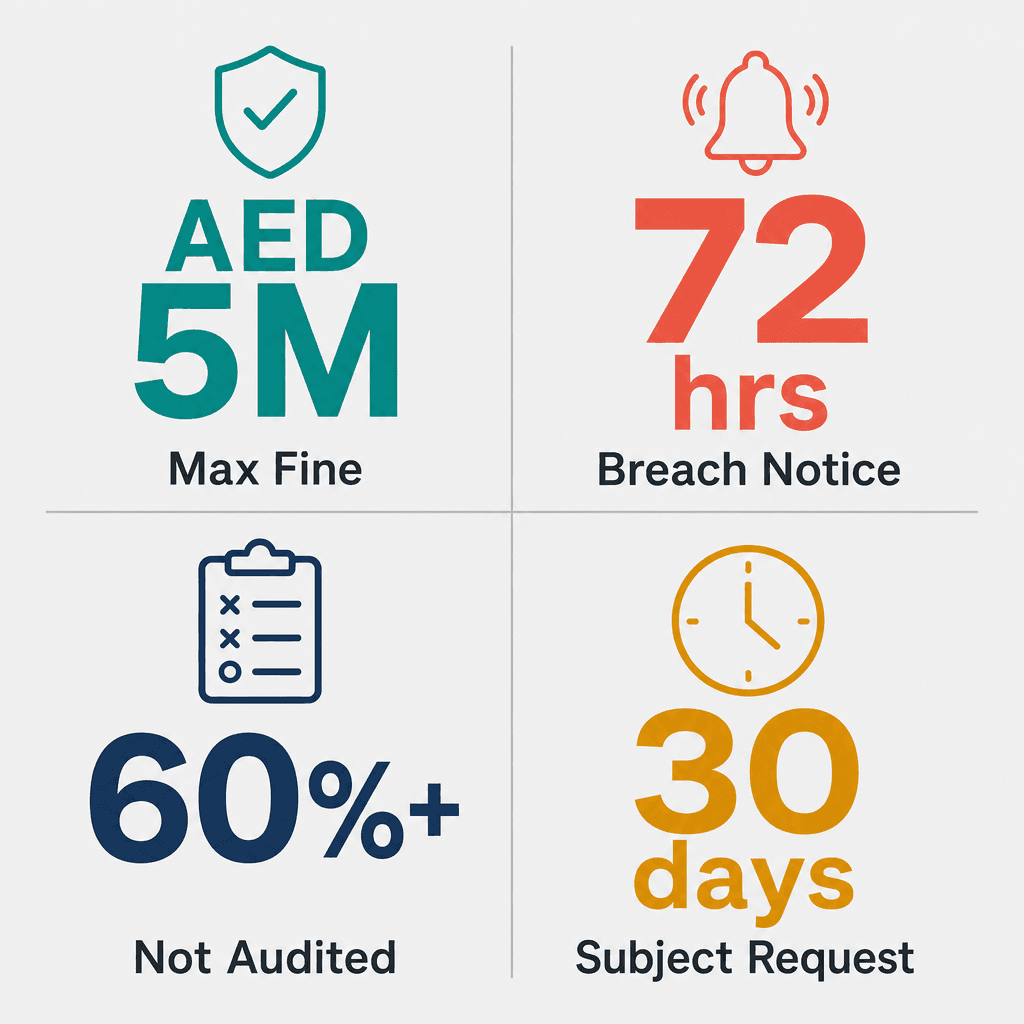
Data protection laws UAE businesses must comply with are governed by Federal Decree-Law No. 45 of 2021, known as the Personal Data Protection Law (PDPL). It applies to all businesses processing personal data of UAE residents, sets consent and breach notification obligations, and carries penalties up to AED 5,000,000 for violations.
What Is the UAE PDPL and When Did It Take Effect
Federal Decree-Law No. 45 of 2021 is the primary federal data protection legislation in the UAE, enacted in October 2021. Implementing regulations followed under Cabinet Decision No. 33 of 2022, with full enforcement active from 2023 onward. The UAE Data Office (UDO), operating under the UAE Government, serves as the central federal supervisory body responsible for enforcement and guidance (UAE Data Office, 2026).
The PDPL doesn't operate in isolation. It sits alongside sector-specific rules from TDRA (Telecommunications and Digital Government Regulatory Authority), DHA (Dubai Health Authority), and RERA (Real Estate Regulatory Agency), each applying to their regulated industries. So if you're in healthcare, real estate, or telecoms, you're dealing with layered obligations, not just the federal baseline.
A Dubai-based e-commerce platform collecting customer email addresses and purchase history became subject to PDPL obligations from the moment the implementing regulations came into force, regardless of whether they had updated their privacy policy. That's worth noting: ignorance of the law isn't a recognised defence under the PDPL.
How UAE Data Protection Law Defines Personal Data
Under the PDPL, personal data means any information that identifies or can identify a natural person, directly or indirectly. That covers names, email addresses, IP addresses, device identifiers, and location data. Sensitive personal data, defined under Article 4 of Federal Decree-Law No. 45 of 2021, goes further: health records, biometric data, financial data, racial or ethnic origin, and religious beliefs all fall into this category and attract stricter controls (UAE Data Office, 2026).
Anonymised data that genuinely cannot be re-linked to an individual falls outside PDPL scope. Pseudonymised data that can still be re-linked remains within scope. A Dubai health clinic storing patient biometric records must apply the PDPL's enhanced consent and security requirements for sensitive personal data, not just the standard consent process used for marketing emails. That distinction matters practically, the compliance obligations are meaningfully different.
Who Must Comply with UAE PDPL
Any business, mainland, free zone, or foreign, that processes personal data of UAE residents must comply with the UAE PDPL. This includes SMEs, tech companies, marketing agencies, healthcare providers, and e-commerce platforms. There is no minimum employee or revenue threshold for applicability.
Mainland, Free Zone, and Foreign Businesses, Who Is Covered
The PDPL applies to any entity processing data of UAE residents, regardless of where the entity is incorporated. That's the extraterritorial reach confirmed under Article 2 of Federal Decree-Law No. 45 of 2021. Free zone companies in Dubai South, JAFZA, DAFZA, and other non-financial free zones are subject to federal PDPL. A Singapore-based SaaS company with UAE clients storing user data in Dubai data centres is subject to PDPL obligations, even without a UAE trade license.
The key exceptions are DIFC and ADGM. DIFC (Dubai International Financial Centre) operates under the DIFC Data Protection Law 2020, enforced by the DIFC Commissioner of Data Protection (DIFC Commissioner of Data Protection, 2026). ADGM (Abu Dhabi Global Market) has its own ADGM Data Protection Regulations 2021. Businesses in either financial free zone must comply with their zone's own regime, not the federal PDPL.
Industry-Specific Data Obligations in UAE
The DHA Health Data Governance Framework 2024 applies to all licensed Dubai health facilities, adding a layer of health data rules on top of PDPL. RERA requires real estate agents to manage client data in line with both PDPL and RERA data handling guidelines. MOHRE mandates employee personal data retention standards for all companies with UAE work permit holders (MOHRE, 2026). Financial institutions under CBUAE oversight face combined obligations from both PDPL and CBUAE data governance rules.
A Dubai real estate brokerage must satisfy both RERA client data handling rules and the federal PDPL consent requirements. Failure to align both layers can trigger parallel regulatory action from two separate authorities, that's double the exposure, and it happens more often than businesses expect. If you're also working through your UAE AML and KYC requirements, note that customer data collected for KYC purposes carries its own PDPL obligations around retention and access.
Key Obligations Under UAE Data Protection Law
UAE PDPL obligations include obtaining valid consent before processing personal data, appointing a data protection officer for certain businesses, implementing data localisation where required, maintaining processing records, and notifying the UAE Data Office of breaches within 72 hours. Non-compliance with data protection laws UAE regulators enforce carries fines up to AED 5,000,000.
Step-by-Step Guide to PDPL Compliance for UAE Businesses
A Dubai-based marketing agency processing customer email lists for 15 clients completed a six-step PDPL audit in eight weeks, updating consent forms, processor agreements, and their breach notification protocol, avoiding an estimated AED 500,000 fine exposure. Here's the process they followed:
Conduct a personal data audit. Map every category of data your business collects, stores, and shares. Include third-party processors and cloud platforms.
Update your privacy policy. Reflect PDPL requirements, including lawful bases for processing and data subject rights. An Arabic-language version is expected for UAE-facing businesses.
Implement a valid consent mechanism. Pre-ticked boxes do not satisfy PDPL. Consent must be specific, informed, and freely given (UAE Data Office, 2026).
Appoint a Data Protection Officer (DPO). Required where processing involves large-scale sensitive data or systematic monitoring, per Article 11 of Federal Decree-Law No. 45 of 2021.
Review third-party data sharing agreements. Ensure all processors sign data processing agreements aligned with PDPL before any data is transferred.
Data Localisation and Cross-Border Transfer Rules
The PDPL restricts transfer of personal data outside the UAE to countries with adequate data protection levels or with appropriate safeguards in place, under Article 26 of Federal Decree-Law No. 45 of 2021. The UAE Data Office publishes an approved country list, transfers to unlisted countries require contractual safeguards or explicit consent from the data subject (UAE Data Office, 2026).
Cloud service providers storing UAE resident data must confirm data residency or implement approved transfer mechanisms. A UAE fintech transferring customer KYC data to a parent company in Germany must verify Germany's adequacy status under the PDPL approved country list or execute a standard contractual clause approved by the UAE Data Office. Data localisation is also mandatory for certain government and critical infrastructure datasets under separate UAE cybersecurity regulations issued by TDRA.
Data Subject Rights in UAE
Under UAE data protection law, individuals have the right to access their personal data, correct inaccuracies, request deletion, withdraw consent, and object to direct marketing. Businesses must respond to data subject requests within 30 days. Ignoring these rights is a direct PDPL violation under personal data protection UAE obligations.
Eight Rights Every UAE Business Must Honour
Right of access: individuals can request a copy of all personal data you hold about them.
Right to rectification: individuals can demand correction of inaccurate or incomplete data.
Right to erasure: the right to be forgotten, applies when data is no longer necessary or consent is withdrawn.
Right to data portability: individuals can request their data in a machine-readable format.
Right to object: individuals can object to processing for direct marketing at any time.
Right to restrict processing: individuals can limit how you use their data in specific circumstances.
Right not to be subject to automated decisions: restrictions under Article 17 of PDPL apply to profiling with legal or significant effects.
Right to withdraw consent: withdrawal must be as easy as giving consent, no friction allowed.
A UAE-based subscription service received 12 erasure requests in Q1 2026. Under PDPL, each must be actioned within 30 days (Federal Decree-Law No. 45 of 2021). Failure across all 12 could trigger a separate violation count per request, that's 12 potential enforcement actions from a single wave of requests.
How to Build a Data Subject Request Process
Create a dedicated data subject request form or email channel and publish it clearly in your privacy policy.
Log every incoming request with the date received and the category of right invoked.
Verify the identity of the requestor before disclosing or deleting data, identity verification is a PDPL-compliant safeguard (UAE Data Office, 2026).
Respond formally in writing within 30 days, document the outcome, and retain records for regulatory audit.
Dubai South Business Hub Free Zone clients use a standardised data subject request log template as part of their PDPL compliance pack, reducing average response time to under seven working days. Having a process in place before requests arrive is the difference between a smooth response and a scramble that misses the 30-day window.
Does the UAE PDPL apply to small businesses?
Yes. Federal Decree-Law No. 45 of 2021 contains no minimum employee count or revenue threshold. A sole trader collecting client email addresses for invoicing is subject to PDPL obligations. The scale of your obligations increases with the volume and sensitivity of data you process, but the baseline requirement to have a lawful basis for processing applies to every business from day one.
Data Breach Notification Requirements
UAE PDPL requires businesses to notify the UAE Data Office within 72 hours of discovering a personal data breach that poses a risk to individuals. If the breach is high-risk, affected individuals must also be notified without undue delay. Failure to report carries fines up to AED 5,000,000 under data protection laws UAE regulators actively enforce.
What Counts as a Notifiable Breach Under UAE PDPL
A breach is any accidental or unlawful destruction, loss, alteration, unauthorised disclosure of, or access to personal data. Not every breach triggers notification, only those that create a real risk of harm to data subjects. Low-risk breaches, such as an accidental internal email misdirection with no sensitive data attached, may be documented internally without external notification.
High-risk breaches involving sensitive data, financial information, or large-scale exposure always trigger mandatory notification to the UAE Data Office under Article 22 of Federal Decree-Law No. 45 of 2021, with TDRA cybersecurity incident coordination for critical sectors at tdra.gov.ae (TDRA, 2026). A Dubai logistics company suffered a ransomware attack in 2025 exposing 4,200 customer shipping records including national ID numbers. Under PDPL, they were required to notify the UAE Data Office within 72 hours and inform all affected customers within a further 48 hours.
Building a 72-Hour Breach Response Protocol
Detect and contain. Isolate affected systems and confirm the scope of the breach within the first 12 hours.
Assess risk. Determine whether the breach meets the PDPL notification threshold based on data type and volume exposed.
Notify the UAE Data Office via uaedataoffice.gov.ae with breach details, categories of data affected, and remediation steps taken.
Notify affected individuals if the breach is high-risk, with clear guidance on protective actions they should take.
Document the full incident, response timeline, and lessons learned for regulatory audit readiness.
A Dubai-based HR platform that had rehearsed its breach response protocol managed to file its UAE Data Office notification within 58 hours of a credential-stuffing incident, avoiding a procedural fine entirely. Rehearsing the protocol before an incident is the single most practical step most UAE businesses skip.
UAE PDPL vs GDPR vs DIFC Data Protection
UAE PDPL, GDPR, and DIFC Data Protection Law share core principles, consent, data subject rights, breach notification, but differ in scope, enforcement authority, and penalties. GDPR applies globally with fines up to EUR 20 million. DIFC's law applies only within the DIFC financial free zone with its own Commissioner. Understanding which UAE data protection regime applies to your business is not optional.
UAE PDPL vs GDPR vs DIFC Data Protection Law, Key Comparison 2026
Feature | UAE PDPL (Federal) | DIFC Data Protection Law | GDPR (EU) |
|---|---|---|---|
Applicable Territory | UAE mainland and all non-financial free zones (e.g. Dubai South, JAFZA, DAFZA) | DIFC financial free zone entities only | Any entity processing EU data subjects' data, globally |
Supervisory Authority | UAE Data Office (uaedataoffice.gov.ae) | DIFC Commissioner of Data Protection | National DPAs within EU member states |
Maximum Fine | AED 5,000,000 per violation (Article 41) | USD 100,000 per violation | EUR 20,000,000 or 4% of global annual turnover |
Breach Notification Window | 72 hours to UAE Data Office (Article 22) | 72 hours to DIFC Commissioner | 72 hours to national supervisory authority |
DPO Requirement | Required for large-scale sensitive data processing (Article 11) | Required for systematic large-scale processing | Required for systematic large-scale processing or public authority |
Data Localisation | Approved country list required; unlisted countries need safeguards or consent | Adequacy decision or appropriate safeguards required | Adequacy decision or appropriate safeguards (SCCs, BCRs) |
Primary Lawful Basis | Consent is the central mechanism; limited recognition of legitimate interests | Consent plus legitimate interests recognised | Six lawful bases including legitimate interests, contract, legal obligation |
What GDPR-Compliant Businesses Still Need to Do for PDPL
GDPR compliance does not automatically satisfy UAE PDPL, and this is the mistake most European businesses entering the UAE market make. There are structural differences in lawful bases, DPO thresholds, and transfer mechanisms that require a dedicated gap analysis. The UAE PDPL does not recognise "legitimate interests" as a standalone lawful basis in the same way GDPR does, consent is far more central under UAE law (UAE Data Office, 2026).
A European SaaS company entering the UAE market in 2026 assumed its GDPR compliance pack transferred automatically. A gap analysis revealed three PDPL-specific gaps: no Arabic-language privacy notice, no UAE Data Office registration, and no PDPL-aligned consent mechanism for UAE users. Cross-border transfer adequacy lists also differ, a country adequate under GDPR may not appear on the UAE Data Office approved list. Run the gap analysis before you go live, not after.
Worth flagging: ADGM Data Protection Regulations 2021 apply within Abu Dhabi Global Market (ADGM, 2026), creating a third distinct regime alongside federal PDPL and DIFC. If your business spans multiple UAE jurisdictions, you may need to satisfy more than one framework simultaneously.
Penalties for Non-Compliance with UAE Data Protection Laws
Penalties under data protection laws UAE regulators enforce reach AED 5,000,000 for serious violations such as unlawful processing of sensitive data or failure to notify a breach. Repeat offences attract doubled fines. The UAE Data Office also has authority to order suspension of data processing activities pending corrective action.
Fine Structure Under Federal Decree-Law No. 45 of 2021
Tier 1, minor procedural breaches (e.g., inadequate privacy notice): fines from AED 50,000.
References
DIFC Commissioner of Data Protection (difc.ae)