Table of Contents Why UAE Digital Creators Need Legal Structure License Options for Digital Creators in UAE How to Invoice Clients as a UAE Creator Accepting International Payments as a UAE Creator Business Bank Account…
Table of Contents
Why UAE Digital Creators Need Legal Structure
License Options for Digital Creators in UAE
How to Invoice Clients as a UAE Creator
Accepting International Payments as a UAE Creator
Business Bank Account for Creators
VAT for Digital Creators in UAE
Common Mistakes Creators Make with UAE Income
How Dubai South Business Hub Free Zone Helps
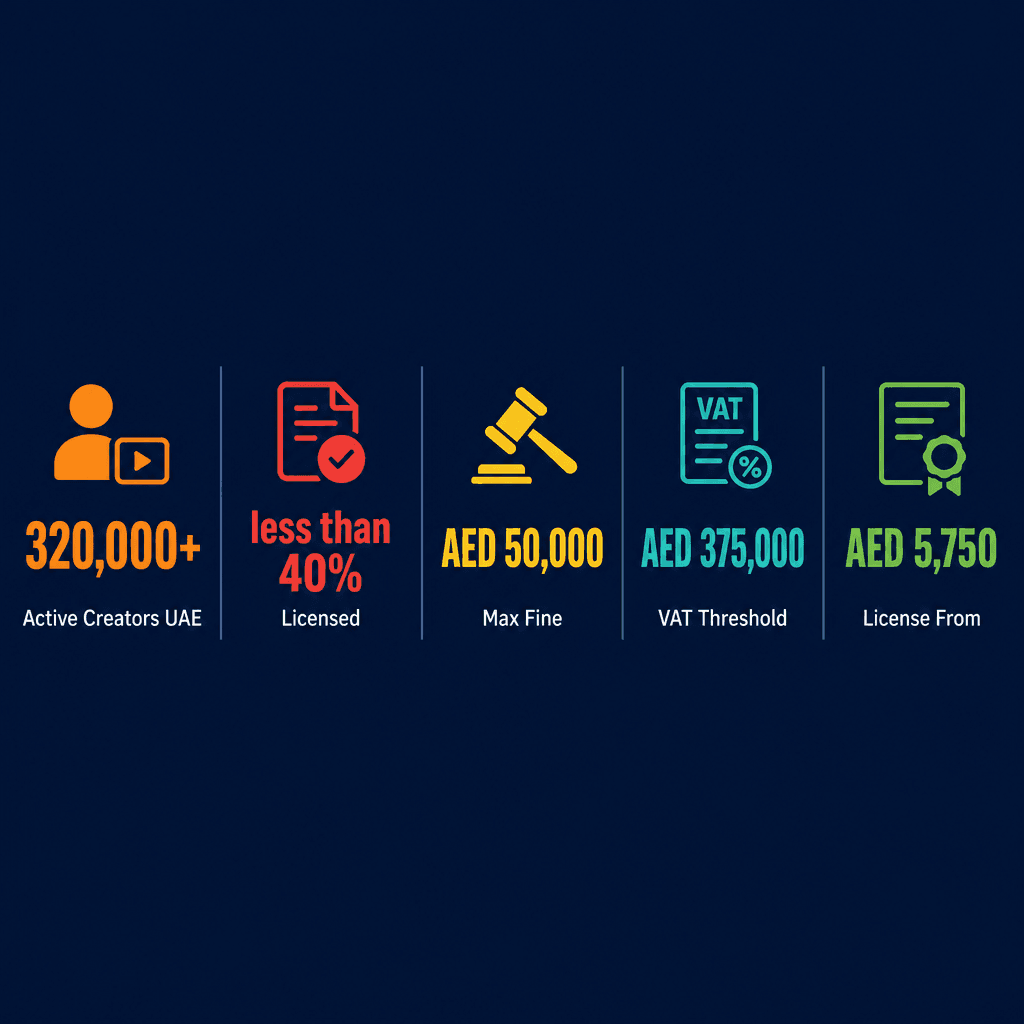
In 2026, over 320,000 active content creators operate across the UAE, generating an estimated AED 4.2 billion in digital income annually (UAE Ministry of Economy, 2026). Fewer than 40% hold a valid trade license, leaving the majority legally exposed when invoicing clients or receiving international payments (DED, 2026). Fines for unlicensed commercial activity reach up to AED 50,000 under Dubai Economic Department enforcement (DED, 2026). The VAT registration threshold sits at AED 375,000 in annual turnover (Federal Tax Authority, 2026). A free zone media license starts from AED 5,750 per year (Dubai South Business Hub Free Zone, 2026).
Digital creators invoicing UAE clients must hold a valid trade license to issue legal invoices. Without one, income from brand deals or platform monetisation is unlicensed commercial activity under UAE Federal Law No. 37 of 1992, and your invoices are not enforceable in UAE courts. If you're already earning from content and haven't licensed up yet, read our full influencer license Dubai guide before your next invoice goes out.
This guide covers the exact license options, invoicing steps, international payment tools, VAT obligations, and the simplest legal structure for digital creators managing income in the UAE.
Why UAE Digital Creators Need Legal Structure
UAE digital creators need a trade license to legally invoice clients, receive payments into a business account, and comply with Federal Law No. 37 of 1992 on commercial activities. Without a license, income from brand deals, sponsorships, or platform monetisation is considered unlicensed commercial activity, which carries fines from MOHRE (mohre.gov.ae). This isn't a grey area. The moment you accept recurring payment for content, you're running a commercial operation under UAE law.
What Counts as Commercial Activity for a Creator
Any recurring income from brand partnerships, sponsored posts, or platform ad revenue qualifies as a commercial activity under UAE Federal Law No. 37 of 1992. MOHRE and DED (dubai.gov.ae) classify content monetisation under media and entertainment activity codes, not personal income. That distinction matters enormously when a bank or brand agency asks for documentation.
One-off gifts or personal transfers below AED 1,000 generally don't cross into commercial territory. Recurring sponsorship deals always do. A Dubai-based fitness influencer earning AED 15,000 monthly from brand partnerships is conducting a licensable commercial activity, whether payments arrive via bank transfer or PayPal. Operating without a license exposes that creator to DED fines of up to AED 50,000 (DED, 2026).
Why a License opens up Your Full Income Potential
A valid trade license lets you open a corporate bank account, which most brand agencies require before issuing payment. Licensed creators can register for VAT, issue tax-compliant invoices, and attract larger international brand contracts that require vendor documentation. Without a license, platforms like Stripe and many UAE banks won't process business-volume transactions without triggering compliance flags.
MOHRE recognition also protects you under UAE labour and commercial dispute frameworks if a client defaults on payment. Think about what that means practically: a licensed creator can sign a formal vendor agreement with a multinational brand requiring a trade license copy, VAT certificate, and a UAE corporate bank account. None of that is accessible without legal structure. Fewer than 40% of UAE creators are currently in this position (DED, 2026), which means the licensed minority has a clear competitive advantage when chasing premium contracts.
License Options for Digital Creators in UAE
UAE digital creators can choose between a DED mainland freelance permit, a free zone media or influencer license, or a full free zone trade license. Free zone licenses start from AED 5,750 per year, offer 100% foreign ownership, and are the fastest route to legal invoicing for most content creators in 2026. For freelance invoicing UAE creator setups and content creator payments Dubai-side, the free zone route wins on cost and speed.
Freelance Permit vs. Media License vs. Influencer License
Freelance Permit (available via DED or free zones like twofour54 and DAFZA): lets you invoice under your own name. Suitable for writers, photographers, and video editors with a single activity. Issues a 1-year residency visa via ICP (icp.gov.ae).
Media License: covers production, broadcasting, and content publishing. Best for creators running a content studio or managing a team. Available mainland and free zone.
Influencer License: issued under the National Media Council (NMC, nmc.gov.ae) framework. Mandatory if you monetise social media accounts with over 10,000 followers in the UAE. NMC fee: AED 15,000 for 2 years (NMC, 2026). Free zone equivalent starts from AED 5,750/year (Dubai South Business Hub Free Zone, 2026).
A YouTube creator with 85,000 subscribers monetising via AdSense and brand deals requires an influencer license under NMC rules. A standard freelance permit alone does not cover social media monetisation activity. That's a detail many creators miss until they're mid-contract with a brand.
Free Zone vs. Mainland: Which Is Right for You
Free zone licenses offer 100% foreign ownership (UAE Cabinet Resolution, 2021), 0% corporate tax on qualifying income, and faster setup at 3-5 business days. Mainland DED licenses allow you to contract directly with UAE government entities and operate physical offices anywhere in the emirate, but they cost AED 12,000-20,000+ and take 10-15 business days to set up.
For most solo digital creators, the free zone route is the faster, cheaper, and more administratively simple option. A UK-national travel vlogger relocating to Dubai chose a Dubai South Business Hub Free Zone media license at AED 5,750 over a DED mainland permit at AED 12,000+, with setup completed in 4 business days. The free zone is 57% cheaper on entry cost and three times faster to establish.
UAE Creator License Options - Fees, Timelines and Eligibility (2026)
License Type | Issuing Authority | Annual Fee (AED) | Setup Time | Visa Eligible | Best For |
|---|---|---|---|---|---|
Freelance Permit | DED / twofour54 | 7,500 - 12,000 | 7-10 days | 1-year visa | Solo writers, editors, photographers |
Influencer License | NMC / Free Zone | 5,750 - 15,000 | 3-7 days | 2-3 year visa | Social media creators, 10K+ followers |
Media License (Free Zone) | Dubai South Business Hub Free Zone | 5,750+ | 3-5 days | 2-3 year visa | Content studios, vloggers, podcasters |
Media License (Mainland) | DED Dubai | 12,000 - 20,000 | 10-15 days | 2-3 year visa | Agencies, government contractors |
How to Invoice Clients as a UAE Creator
To invoice clients legally as a UAE digital creator, you need a valid trade license, a business bank account in the company name, and a compliant invoice that includes your license number, VAT registration number (if applicable), payment terms, and the client's legal entity name. Invoices without a license number are not legally enforceable in UAE courts. Digital creators invoicing UAE clients who skip this step are essentially working on trust alone, not a position you want to be in with a large brand.
Step-by-Step: Creating a Legal Invoice as a UAE Creator
Obtain your trade license and confirm the activity description covers your invoicing category: media production, content creation, social media management, or consulting.
Open a UAE business bank account in your company or trade name. Emirates NBD, Mashreq Neo, and RAKBANK are widely used by free zone creators.
Use invoicing software (FreshBooks, Zoho Invoice, or Wave) to generate invoices that include: company name, trade license number, invoice date, unique invoice number, itemised services, currency, payment due date, and bank IBAN.
Add VAT details if your annual turnover exceeds AED 375,000. Include your Federal Tax Authority (FTA) Tax Registration Number (TRN) and a 5% VAT line on every invoice for UAE-based clients (FTA, 2026).
Send as PDF and retain a copy for 5 years per UAE Commercial Transactions Law requirements (FTA, 2026).
A Dubai-based podcast creator invoicing a regional bank for a sponsored 6-episode series at AED 30,000 includes: trade license number, bank IBAN, invoice number 001, service description, and 30-day payment terms. That invoice is legally enforceable under UAE Commercial Law. Without the license number, it isn't.
What Must Appear on Every UAE Creator Invoice
Mandatory fields for freelance invoicing UAE creator compliance: company or trade name, trade license number, invoice date, unique invoice number, client legal name, itemised services with AED amounts, total amount, payment terms, and bank account details. For VAT-registered creators, the invoice must separately show the 5% VAT rate, the VAT amount in AED, and the FTA TRN.
Invoices in foreign currency (USD, EUR, GBP) are permitted but must state the AED equivalent at the exchange rate on the invoice date per FTA guidance. An invoice for a USD 5,000 brand deal from a US client must state the AED equivalent, AED 18,360 at the fixed 3.672 rate (UAE Central Bank, 2026). That one line keeps you FTA-compliant on cross-border deals. For more on digital business licensing, see the e-commerce licensing in Dubai guide.
Accepting International Payments as a UAE Creator
UAE digital creators can legally receive international payments via Stripe, PayPal, Wise Business, or direct SWIFT bank transfer into a UAE corporate account. Stripe has been available in the UAE for licensed entities since 2023. All foreign income must be received into a business account registered to your trade license to stay compliant with UAE banking AML regulations. This is how digital creators get paid UAE-legally, not through personal accounts.
Stripe, PayPal, and Wise for UAE Creators
Stripe UAE: available to licensed entities since 2023. Requires a trade license, UAE business bank account, and Emirates ID. Processing fee: 2.9% + AED 1.00 per transaction (Stripe, 2026).
PayPal: available for sending and receiving in the UAE, but withdrawals to UAE bank accounts carry a 2.5% currency conversion fee and a 30-day rolling reserve for new accounts. Not suitable as a primary channel for high-volume content creator payments Dubai-side.
Wise Business: hold USD, GBP, EUR, and AED balances, send invoices in multiple currencies, and convert at mid-market rates. Transfer fee: 0.35-1.5% depending on the currency pair (Wise, 2026). A Dubai creator invoicing a US brand for USD 8,000 via Wise saves AED 320 versus PayPal's 2.5% conversion fee.
SWIFT bank transfer: the most reliable and lowest-fee option for invoices above AED 10,000. Most UAE corporate banks process incoming SWIFT transfers within 1-3 business days with zero incoming wire fee.
Platform Monetisation Income: YouTube, TikTok, and Meta
YouTube AdSense, TikTok Creator Fund, and Meta in-stream ads all pay into registered payment accounts. Platform payments are classified as foreign-source commercial income and must flow through your business account, not a personal account, to remain compliant with UAE banking AML regulations. UAE AML rules require commercial income above AED 55,000 per transaction to be reported (UAE Central Bank, 2026).
A UAE-resident TikTok creator earning USD 3,500 per month from the TikTok Creator Fund routes payments to a Wise Business account linked to their free zone trade license, fully compliant with UAE banking AML rules. Google AdSense payout threshold is USD 100 per payment cycle, so even early-stage creators need their business account in place before income accumulates. Ready to set up that structure? Launch your company at Dubai South Business Hub Free Zone and have your account-ready license in 3-5 business days.
Business Bank Account for Creators
UAE digital creators need a business bank account registered to their trade license to legally receive client payments and platform income. Emirates NBD, Mashreq Neo Business, and RAKBANK SME accounts are the most accessible options for free zone creators in 2026, with minimum balance requirements ranging from AED 0 to AED 25,000. Digital creator income UAE legal compliance depends on this account being in your business name, not your personal name.
Best UAE Banks for Free Zone Creators in 2026
Emirates NBD Business: minimum balance AED 25,000, full SWIFT and IBAN capability, accepts free zone companies. Best for creators with established income above AED 15,000 per month.
Mashreq Neo Business: AED 0 minimum balance, fully digital onboarding, accepts free zone licenses. Monthly fee AED 50 if balance falls below AED 10,000. Ideal for new creators.
RAKBANK SME Account (rakbank.ae): AED 0 minimum for first 6 months, multi-currency receiving, free zone companies accepted. Strong for creators receiving USD and EUR income.
Wio Business (Abu Dhabi): digital-first, no minimum balance, accepts free zone licenses, onboarding within 3 business days. Increasingly popular with the UAE creator community.
A new Dubai South Business Hub Free Zone media licensee opened a Mashreq Neo Business account online in 2 business days with zero minimum balance and received their first brand payment within the same week.
Documents Required to Open a Creator Business Account
Valid trade license
Emirates ID (original)
Passport copy and visa page copy
Proof of registered business address (free zone tenancy certificate or Ejari)
Certificate of Incorporation and Memorandum of Association (free zone companies)
Completed bank KYC form
Opening a RAKBANK SME account as a free zone creator requires all of the above, all submittable digitally via the RAKBANK app (rakbank.ae). Processing time ranges from 2 business days (Mashreq Neo, Wio) to 15 business days (Emirates NBD, FAB). Enhanced KYC review is triggered above AED 50,000 per month in income, so if you're near that threshold, apply early.
VAT for Digital Creators in UAE
UAE digital creators must register for VAT with the Federal Tax Authority (FTA) once annual taxable turnover exceeds AED 375,000. The standard rate is 5%, applied to invoices for UAE-based clients. International brand deals with non-UAE clients are typically zero-rated. Voluntary registration is available from AED 187,500 turnover. Digital creators invoicing UAE clients near either threshold should track income monthly, not annually.
When You Must Register for VAT as a Creator
Mandatory VAT registration threshold: AED 375,000 in taxable supplies in any 12-month period (FTA, 2026). Voluntary registration threshold: AED 187,500, worth doing if you want to reclaim input VAT on equipment, software, and studio costs. Platform income from YouTube AdSense or TikTok Creator Fund counts toward your taxable turnover even though the payer is outside the UAE.
A Dubai creator earning AED 200,000 from UAE brand deals and AED 180,000 from YouTube AdSense crosses the AED 375,000 threshold and must register for VAT within 30 days of crossing it. Once registered, you file quarterly returns via the FTA portal (tax.gov.ae) and pay any VAT owed within 28 days of the quarter end. Late registration carries a AED 20,000 penalty (FTA, 2026).
Zero-Rated vs. Standard-Rated Creator Income
UAE-based client invoices (local brand deals, UAE agency contracts): 5% VAT applies. You add VAT and remit to FTA.
International client invoices (US, UK, European brands paying from outside UAE): zero-rated at 0% VAT under FTA export-of-services rules, per Federal Decree-Law No. 8 of 2017. No VAT charged.
Digital platform payments (YouTube, TikTok, Meta, Spotify): treated as export-of-services, zero-rated, but still count toward your taxable turnover threshold.
A creator invoicing Emirates Airlines (UAE entity) charges AED 20,000 + AED 1,000 VAT at 5%. The same creator invoicing Nike USA charges AED 20,000 at 0% VAT. Both are correct. Creators who incorrectly charge 5% on zero-rated international invoices create a compliance risk, the client may dispute the invoice and FTA may require a corrective tax credit note.
Common Mistakes Creators Make with UAE Income
The most common mistakes UAE digital creators make with income management include receiving payments into personal accounts, invoicing without a trade license, missing VAT registration deadlines, and using non-licensed payment tools. Each of these exposes creators to DED fines, FTA penalties, and banking compliance flags that can freeze accounts. Digital creators invoicing UAE clients need to understand how digital creators get paid UAE-legally before the first invoice goes out.
The Five Errors That Cost UAE Creators the Most
Receiving brand payments into a personal account: UAE banks flag this as commercial income misclassification and can freeze the account under AML review. A UAE creator who received AED 420,000 in a personal account from three brand deals had their account frozen for 45 days, resolution required a legal letter, trade license, and FTA correspondence.
Invoicing without a trade license: invoices without a license number are legally unenforceable. DED fines reach up to AED 50,000 (DED, 2026).
Missing the VAT registration deadline: FTA imposes a AED 20,000 penalty for late registration (FTA, 2026).
Using PayPal as the sole payment channel: PayPal UAE doesn't support full business account features and imposes a 30-day rolling reserve on new accounts.
Renewing a trade license late: a lapsed license invalidates your invoices during the gap period and can trigger visa cancellation via ICP (icp.gov.ae).
How to Stay Compliant Year-Round
Set a quarterly calendar reminder for VAT return filing (28 days after each quarter end) and annual trade license renewal (60 days before expiry).
Use Zoho Books or QuickBooks to auto-generate compliant invoices and track VAT liability in real time. A creator using Zoho Books reduces compliance admin from 6 hours to under 30 minutes per quarter.
Keep all contracts, invoices, and payment receipts for a minimum of 5 years per UAE Commercial Transactions Law.
Appoint a UAE-registered accountant for annual review once income exceeds AED 200,000. Cost: AED 3,000-8,000 per year, fully recoverable as a business expense.
Four stat cards showing DED fine up to AED 50,000, FTA penalty AED 20,000, AML freeze risk on personal accounts, and compliant license from AED 5,750/year.
mohre.gov.ae (mohre.gov.ae)
dubai.gov.ae (dubai.gov.ae)
icp.gov.ae (icp.gov.ae)
Stripe, 2026 (stripe.com)
Wise, 2026 (wise.com)
rakbank.ae (rakbank.ae)
tax.gov.ae (tax.gov.ae)