In 2026, Dubai South is home to over 25,000 active businesses and anchors one of the largest urban development projects on the planet (Dubai South Business Hub, 2025).
In 2026, Dubai South is home to over 25,000 active businesses and anchors one of the largest urban development projects on the planet (Dubai South Business Hub, 2025). Yet a significant share of enquiries still arrive asking about "Dubai World Central." The two names point to the same location, the same free zone authority, and the same 145 sq km site in southern Dubai. But they do not mean the same thing, and that distinction matters when you are choosing where to license your company. This article clarifies exactly what dubai world central is, how the name evolved into Dubai South, what the free zone covers today, and which term you should actually be using.
What Is Dubai World Central and Where the Name Comes From
Dubai World Central (DWC) is the original name given to a master-planned city developed around Al Maktoum International Airport in the south of Dubai. Announced in 2006, it was conceived as a multi-district urban hub integrating aviation, logistics, business, and residential zones under a single free zone authority. If you have seen both "DWC" and "Dubai South" in your research and wondered whether they are the same thing, the short answer is yes, but the history behind that matters.
The 2006 Announcement and the Airport-Centred Vision
Dubai World Central was announced in 2006 as a purpose-built aerotropolis anchored by Al Maktoum International Airport, covering approximately 145 square kilometres in the Jebel Ali corridor. The concept was deliberately modelled on the aerotropolis theory: economic activity radiating outward from aviation infrastructure, with the airport as the engine rather than a peripheral service node.
Al Maktoum International Airport was designed to eventually handle up to 160 million passengers per year at full build-out, which would make it the world's largest airport by capacity. That ambition set the scale for everything around it.
145 sq km master plan footprint in the Jebel Ali corridor
Al Maktoum International Airport capacity target: 160 million passengers per year at full build-out
Cargo operations already exceeding 250,000 tonnes annually (Dubai South, 2024)
A logistics company licensing under DWC in 2010 would have been issued documents bearing the Dubai World Central branding, the same physical address that today carries Dubai South letterhead. Nothing about the location or the legal entity changed; only the name on the paperwork did.
What 'World Central' Actually Referred To
The name reflected a specific ambition: positioning this site as a global connectivity hub, central to world trade routes between Europe, Asia, and Africa. DWC was not a district name. It was the umbrella brand for the entire development and its free zone authority.
The Dubai Aviation City Corporation (DACC) was established as the governing and licensing authority for the DWC zone. DACC remained in that role through the naming transition, a detail that still causes confusion when older corporate documents surface bearing the DWC designation alongside a DACC stamp. The institution behind both names has always been the same body. For a broader overview of what this area covers today, see our guide on what is Dubai South.
How Dubai World Central Became Dubai South
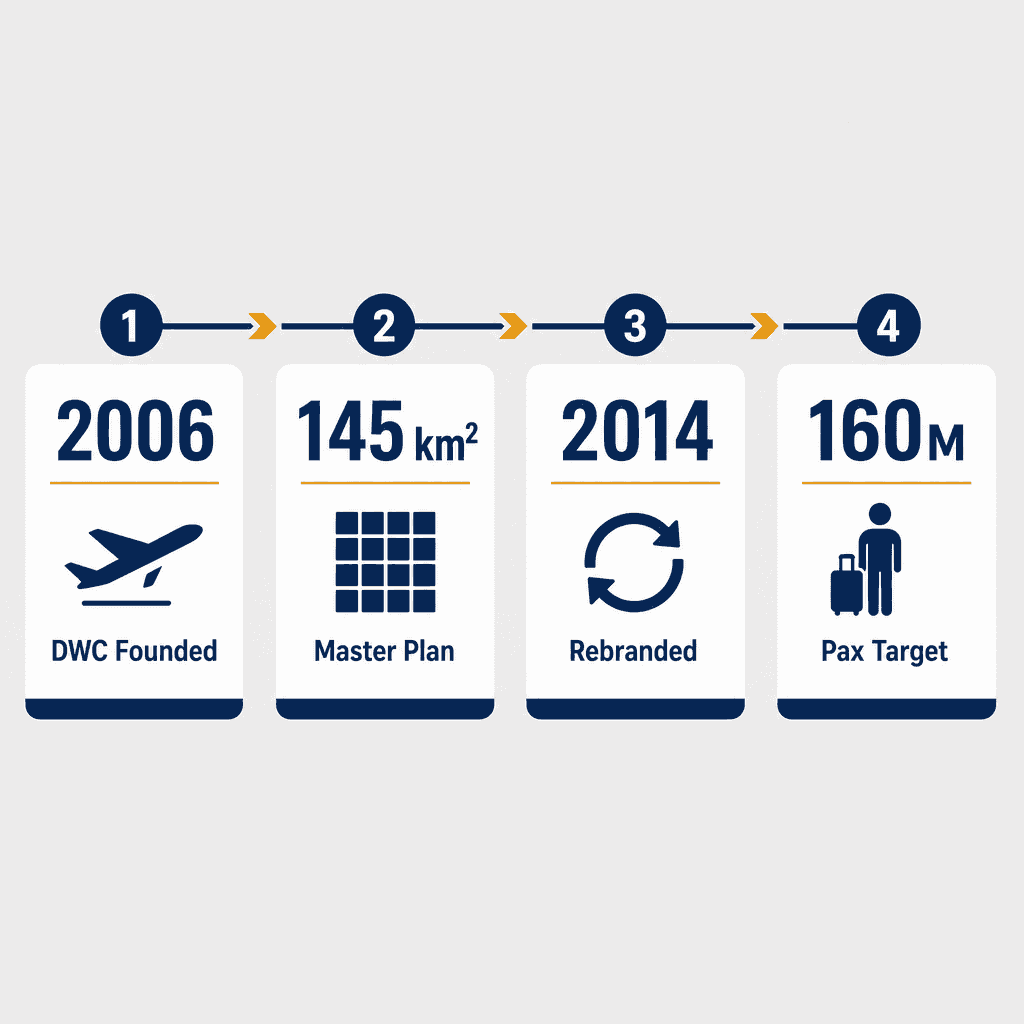
Dubai World Central was officially rebranded as Dubai South in 2014. The rename reflected a strategic shift from an airport-centric identity to a broader smart-city positioning. The underlying free zone authority, licensing framework, and physical boundaries remained the same, only the name and brand direction changed.
The 2014 Rebrand: What Changed and What Did Not
The rebrand to Dubai South was announced in 2014, timed deliberately ahead of the Expo 2020 bid win. The strategic logic was clear: "Dubai South" communicated a liveable, mixed-use city far more effectively than "World Central," which read as a single-function aviation hub to most international audiences.
Here is what actually changed, and what did not:
Changed: The brand name, marketing identity, and signage across the development
Changed: New licenses issued from 2014 onward carry the Dubai South Free Zone designation
Did not change: The governing authority (DACC remained in place)
Did not change: Existing DWC licenses, they remained legally valid; Dubai South branding appeared on subsequent renewals
Did not change: Physical boundaries, districts, or licensing categories
A freight-forwarding company that incorporated under the DWC Free Zone in 2012 would have found its trade license still legally valid post-rebrand, with Dubai South appearing on subsequent renewals. No reissuance was required. That continuity is important to understand if you are reviewing older documents for due diligence purposes.
Why the Old Name Still Circulates
DWC persists in aviation industry contexts for a specific reason: IATA assigned the airport code DWC to Al Maktoum International Airport when the zone was still called Dubai World Central, and that code has not changed. IATA codes are embedded in global flight operations systems, booking platforms, and cargo manifests, changing one is a significant logistical undertaking, so the code stays.
Beyond aviation, older corporate documents, lease agreements, and government registrations still carry the DWC designation. Many business directories and consultant websites have not updated their content, which keeps the old terminology in circulation. High organic search volume for "dubai world central" in 2025 and 2026 confirms that a large audience is still using the original terminology when researching this location. For clarity on which geographical area carries the Dubai South name today, see which area is called Dubai South.
The Districts That Make Up the Dubai South / DWC Master Plan
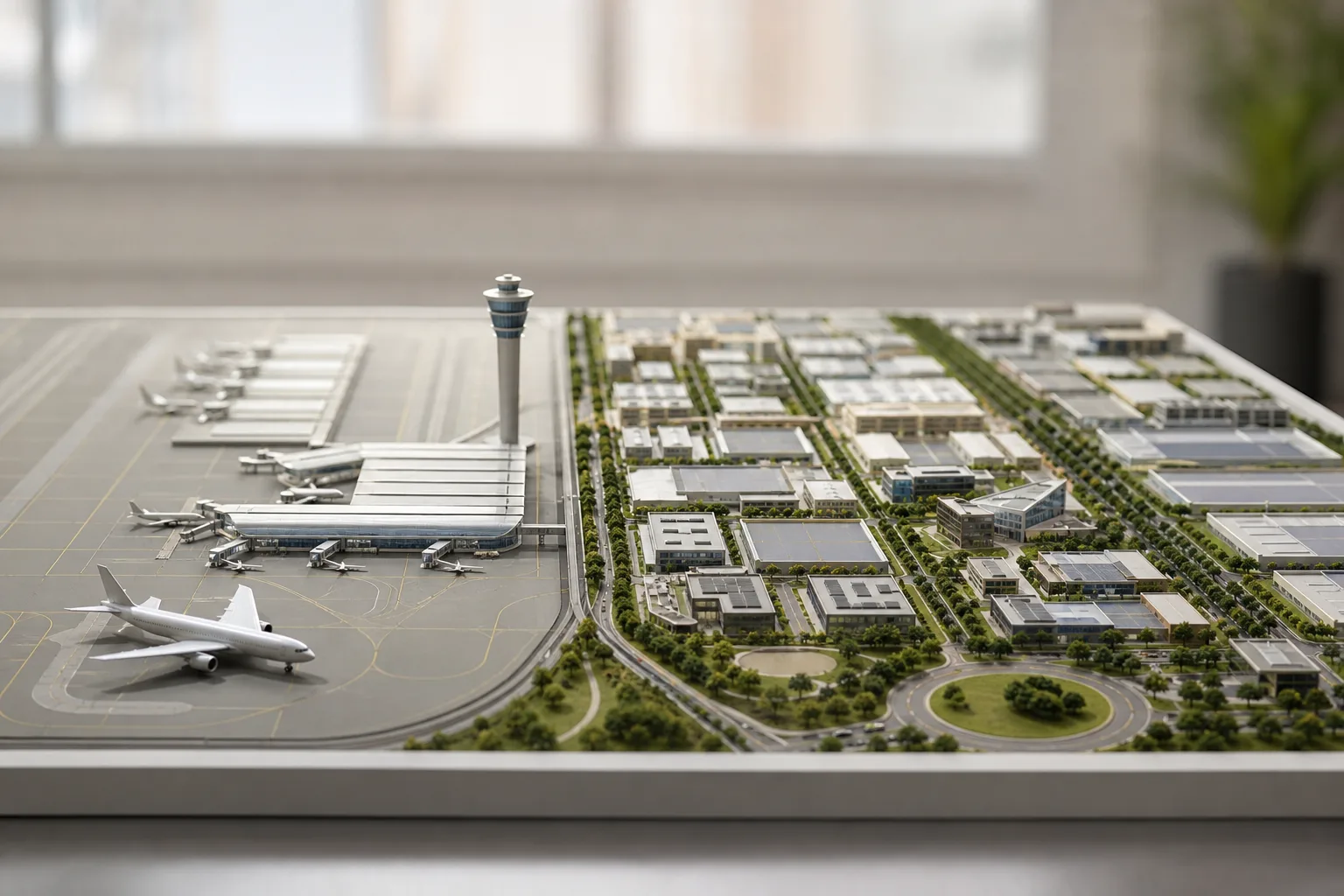
The Dubai South master plan is divided into six purpose-built districts: Aviation, Logistics, Business Park, Commercial, Residential, and the Expo site. Each district targets a specific economic activity. Together they form the integrated city that was originally branded as Dubai World Central when the project launched.
Aviation and Logistics Districts
The Aviation District sits closest to the Al Maktoum International Airport runways and houses MRO (maintenance, repair, and overhaul) operators, aviation training facilities, and airline support services. Dnata, one of the world's largest air services providers, operates ground-handling and cargo facilities within this district, a tangible example of the anchor tenant profile the original DWC vision was designed to attract.
The Logistics District is built for warehousing, freight forwarding, and supply-chain operations, with direct airside and road access. It connects to Jebel Ali Port via the Emirates Road corridor, giving tenants genuine multimodal access. Jebel Ali is the world's largest man-made port and sits within 20 km of the Dubai South boundary, that combination of air and sea access within a single free zone cluster is genuinely rare.
Business Park, Commercial, and Residential Districts
The Business Park District is where most SME and startup free zone licenses are issued. It is the primary address for non-aviation companies registering within the DWC free zone framework, covering trading, professional services, technology, and consultancy activities.
The Commercial District covers retail, hospitality, and mixed-use development. The Residential District, which includes the Emaar South gated community, houses the workforce population living within or near the free zone. These three districts represent the "city" layer of the master plan, the element that made "Dubai South" a more accurate name than "World Central."
Aviation District: MRO, airline services, ground handling
Logistics District: Warehousing, freight, supply chain
Business Park: SME and startup free zone licenses
Commercial: Retail, hospitality, mixed-use
Residential: Emaar South and workforce housing
Expo District: Now District 2020, innovation, conferences, light industrial
For a detailed breakdown of the master plan layout, see our guide on the Dubai South Free Zone master plan.
5 Key Facts About the DWC Free Zone You Need to Know
The DWC Free Zone, now officially the Dubai South Free Zone, offers 100% foreign ownership, zero personal income tax, full profit repatriation, a single-authority licensing process, and direct access to Al Maktoum International Airport. It is one of the UAE's most strategically positioned free zones for logistics, aviation, and trade-focused businesses.
DWC vs Dubai South: Key Differences at a Glance
Feature | Dubai World Central (DWC) | Dubai South |
|---|---|---|
Active name period | 2006 to 2014 | 2014 to present |
Free zone status | Active as DWC Free Zone (legacy name) | Active as Dubai South Free Zone (current name) |
Governing authority | Dubai Aviation City Corporation (DACC) | Dubai Aviation City Corporation (DACC), unchanged |
Airport code | DWC assigned by IATA during this period | DWC retained by IATA, still active for Al Maktoum International Airport |
Foreign ownership | 100% permitted under free zone rules | 100% permitted; confirmed under UAE Federal Decree-Law No. 26 of 2020 |
License entry cost | Varied by activity category | From AED 12,500 at Dubai South Business Hub (DSBH, 2026) |
Physical location | 145 sq km Jebel Ali corridor, south Dubai | Identical, same site, same boundaries |
The Five Facts That Define the Free Zone
Same authority, new name. The Dubai South Free Zone is the direct legal continuation of the DWC Free Zone. Licenses, regulations, and the governing authority (DACC) are unchanged since the rebrand. If you hold a DWC-issued license, you are already a Dubai South Free Zone licensee.
100% foreign ownership. Dubai South Free Zone permits full foreign ownership with no local sponsor requirement, confirmed under UAE Federal Decree-Law No. 26 of 2020. This applies to all license categories within the zone.
Airport proximity is a structural advantage, not a marketing claim. No other UAE free zone sits directly adjacent to a major international cargo airport of this scale. Airside access is a licensed operational right for qualifying tenants, not just a proximity benefit.
License categories are broader than the name suggests. Aviation, logistics, trading, services, and industrial licenses are all available. A technology services company with no aviation connection can license in the Business Park District of Dubai South Free Zone, the same zone that once bore the DWC branding, and operate fully independently of the airport next door.
The Expo 2020 legacy has added real infrastructure. The district that hosted Expo 2020, now called District 2020, has added conference facilities, innovation hubs, and light-industrial space to the broader ecosystem. That is a material expansion of what the original DWC master plan offered.
Free zone licenses start from AED 12,500 at Dubai South Business Hub (DSBH, 2026). Setup timelines typically run 6 to 10 weeks from application to license issuance. For the full licensing breakdown, see our Dubai South Free Zone guide.
DWC vs Dubai South: A Direct Comparison of the Two Terms
DWC (Dubai World Central) is the original name used from 2006 to 2014 for the master development and its free zone. Dubai South is the current official name used from 2014 onward. They refer to the same location and the same free zone authority. DWC now primarily survives as the IATA airport code for Al Maktoum International Airport.
When to Use Each Term
Use "Dubai South" for all current business, licensing, and real estate contexts, it is the live official brand.
Use "DWC" only when referencing the airport code, historical documents, or legacy license paperwork.
Avoid mixing both terms in formal documents, pick one to prevent compliance ambiguity during due diligence.
If a business directory or consultant still uses "DWC Free Zone," treat it as a reference to Dubai South Free Zone and check the source date before relying on cost or procedure details.
What Stays the Same Regardless of the Name You Use
The physical location does not change. Both names point to the same 145 sq km site south of Dubai city, governed by the Dubai Aviation City Corporation. Your rights as a free zone licensee, 100% ownership, zero personal income tax, full profit repatriation, are identical whether your older documents say DWC or your new ones say Dubai South.
The strategic advantages are equally unaffected by the naming history. Airport access, Jebel Ali proximity, and the Expo legacy infrastructure exist regardless of which label you attach to the address. For related context on the geography, see which area is called Dubai South.