
Table of Contents Why UAE Businesses Need a Payment Gateway Top Payment Gateways for UAE Businesses in 2026 Comparison Table - Fees and Features How to Apply for a UAE Payment Gateway Documents Required Payment Gateway…
Table of Contents
Why UAE Businesses Need a Payment Gateway
Top Payment Gateways for UAE Businesses in 2026
Comparison Table - Fees and Features
How to Apply for a UAE Payment Gateway
Documents Required
Payment Gateway for E-Commerce vs Service Businesses
International vs UAE-Based Payment Gateways
How Dubai South Business Hub Free Zone Helps
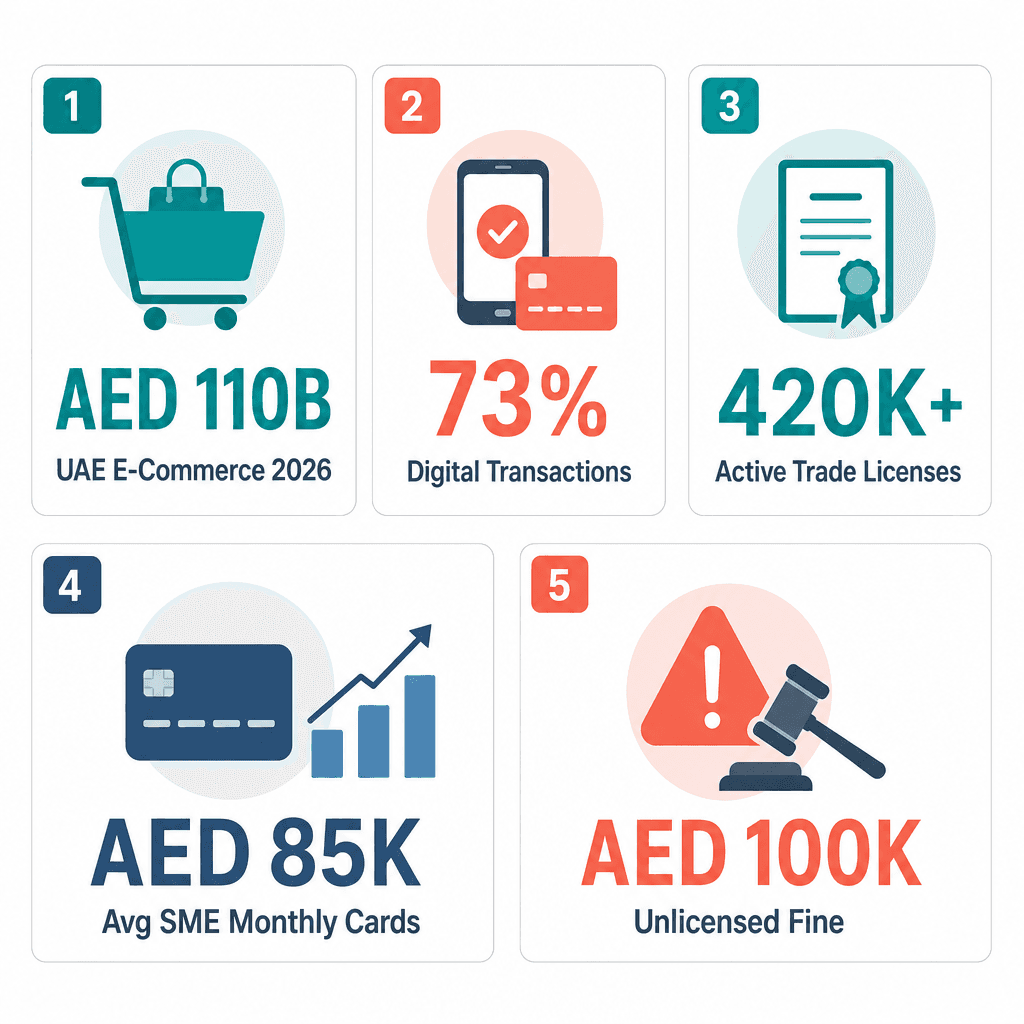
In 2026, UAE e-commerce revenue has crossed AED 110 billion, with digital transactions accounting for 73% of all retail purchases, up from 58% in 2023 (UAE Central Bank, 2026). More than 420,000 active UAE trade licenses now process payments online (Dubai Chamber of Commerce, 2026). The average SME handles AED 85,000 in monthly card transactions. UAE Central Bank fines for unlicensed payment processing start at AED 100,000. Incomplete document sets account for 61% of payment gateway application rejections in the UAE (PayTabs, 2026).
Choosing the right payment gateway UAE is a direct revenue decision, not a back-office technicality. This guide compares Telr, PayTabs, Tap Payments, Network International, Checkout.com, and Stripe UAE on fees in AED, setup requirements, free zone eligibility, and which business type each suits best, so you can get live and processing in under four weeks.
Before you apply to any gateway, you'll need a UAE corporate bank account for fund settlement. Read our guide on how to open a corporate bank account in Dubai to get that step sorted first.
Why UAE Businesses Need a Payment Gateway
A payment gateway UAE is a technology service that authorises and processes card and digital payments between a customer and a UAE-licensed merchant. Without one, businesses cannot legally accept Visa, Mastercard, Apple Pay, or local network payments. The UAE Central Bank mandates that all processors hold a valid Payment Service Provider (PSP) license, and every gateway you use must hold one on your behalf.
What a Payment Gateway Actually Does
Here's the technical reality in plain terms. When a customer enters card details on your checkout page, the payment gateway encrypts that data using TLS and tokenises the card number before it ever reaches your server. It then routes an authorisation request to the customer's issuing bank in real time, typically within two seconds. If approved, funds are settled into your UAE corporate bank account within one to three business days, depending on the gateway.
3D Secure authentication is not optional in the UAE. The UAE Central Bank's Payment Systems Oversight Framework requires 3DS2 compliance for all card-not-present transactions, and every licensed payment gateway UAE processes 3DS automatically. PCI DSS Level 1 compliance is also mandatory for all gateways operating here (UAE Central Bank, 2026).
Consider a practical example: a Dubai-based fashion e-commerce store using Telr processes an AED 450 transaction. The gateway encrypts the card data, routes the authorisation to Emirates NBD's issuing network, applies fraud scoring, and settles AED 438.79 (after the 2.49% fee) into the merchant's Emirates NBD account within 48 hours. The entire process is invisible to the customer.
Why a UAE Trade License Is Non-Negotiable
Every major payment gateway UAE, Telr, PayTabs, Network International, Tap Payments, Checkout.com, and Stripe UAE, requires a valid UAE trade license at the point of merchant onboarding. No license, no gateway. It's that straightforward.
Free zone licenses are accepted by most gateways. Mainland licenses issued by Dubai Economy and Tourism (DET, formerly DED) are accepted by all. The one nuance worth flagging: Stripe UAE accepts mainland licenses and select free zone licenses including DMCC, DIFC, Dubai South, and Dubai Internet City, but not all free zones. Network International requires a UAE acquiring bank relationship in addition to the trade license.
Operating without a licensed gateway is classified by the UAE Central Bank as a regulatory violation, with fines starting at AED 100,000 (UAE Central Bank, 2026). A startup incorporated at a UAE free zone with an active trade license and an Emirates NBD business account can complete Telr onboarding in three to five business days, the fastest legal route to accepting online payments.
Top Payment Gateways for UAE Businesses in 2026
The best payment gateways for UAE businesses in 2026 are Telr, PayTabs, Tap Payments, Network International, Checkout.com, and Stripe UAE. Each suits a different business size and model. Telr and PayTabs are the strongest choices for startups; Network International suits high-volume SMEs; Checkout.com serves enterprise e-commerce. Here's how they break down.
Telr and PayTabs - Best for UAE Startups
Telr charges a one-time setup fee of AED 349 and a transaction fee of 2.49% with no monthly minimum. It supports 120+ currencies, offers Arabic and English checkout natively, and integrates via ready-made plugins for WooCommerce, Shopify, and Magento (Telr, 2026). For a non-technical founder, that means you can be live in a weekend.
PayTabs charges no setup fee but applies 2.85% plus AED 1.00 per transaction. Its recurring billing and invoice tools are stronger than Telr's out of the box, making it the better pick if you're running a subscription model or sending invoices to B2B clients. PayTabs serves 22 countries across MENA (PayTabs, 2026), so it's well-tested for GCC cross-border transactions.
Run the numbers at AED 50,000/month volume: Telr costs roughly AED 1,245 in gateway fees; PayTabs costs approximately AED 1,475. That's AED 230 saved per month on Telr at that volume. Both accept all UAE free zone trade licenses with no acquiring bank pre-arrangement required, a meaningful advantage for free zone startups.
Tap Payments, Network International, and Checkout.com - Best for Growing SMEs
Tap Payments charges no setup fee and a 2.75% transaction fee. It was built specifically for the GCC market and supports Apple Pay and KNET natively, two payment methods that meaningfully lift conversion for UAE and Kuwait customers. If your customer base is regionally concentrated, Tap's local payment rail support is genuinely valuable.
Network International charges AED 500 to AED 1,500 setup depending on plan and offers transaction rates of 1.75% to 2.25%, the lowest standard rates of any gateway on this list. The catch: it requires a UAE acquiring bank relationship and suits merchants processing above AED 200,000/month. Network International processed AED 180 billion in transactions across MENA in 2025 (Network International, 2026), so its infrastructure is proven at scale.
Checkout.com publishes no setup fee and offers negotiated transaction rates of 1.5% to 2.0% for volumes above AED 500,000/month. A UAE SaaS company billing AED 400,000/month negotiated a 1.8% rate with Checkout.com, saving AED 2,760/month compared to Telr's standard 2.49%. Both Checkout.com and Network International require a dedicated account manager onboarding process, neither is self-serve.
Stripe UAE - What Has Changed in 2026
Stripe launched direct UAE entity support in 2023. In 2026, it accepts UAE mainland licenses and select free zone licenses including DMCC, DIFC, Dubai South, and Dubai Internet City. The transaction fee is 2.9% plus AED 1.00 per successful card charge, with no setup fee and no monthly minimum.
Stripe's developer tools are the strongest of any payment gateway UAE option on this list. If your engineering team needs advanced API customisation, webhook reliability, or custom checkout flows, Stripe is the clear choice. Worth flagging: Stripe does not yet support UAE local payment methods such as UAE SWITCH or eDirham natively in 2026, which limits its appeal for merchants targeting domestic UAE consumers.
A Dubai Internet City SaaS startup with a UAE trade license and a Mashreq business account completed Stripe onboarding in two business days in Q1 2026. Stripe supports 135+ currencies globally (Stripe, 2026), making it the right fit for UAE businesses with a predominantly international customer base.
UAE Payment Gateway Fees and Features Comparison 2026
Feature | Telr | PayTabs | Tap Payments | Network International | Checkout.com | Stripe UAE |
|---|---|---|---|---|---|---|
Setup Fee (AED) | 349 | 0 | 0 | 500–1,500 | 0 (negotiated) | 0 |
Transaction Fee (%) | 2.49% | 2.85% | 2.75% | 1.75%–2.25% | 1.5%–2.0% | 2.9% |
Per-Transaction Fee (AED) | None | 1.00 | None | None | None | 1.00 |
Supported Currencies | 120+ | 168+ | GCC-focused | MENA-focused | 20 settlement currencies | 135+ |
Free Zone License Accepted | All UAE free zones | All UAE free zones | All UAE free zones | Yes (+ acquiring bank required) | Yes (account manager onboarding) | DMCC, DIFC, Dubai South, DIC only |
Arabic Checkout | Yes (native) | Yes (native) | Yes | Yes | Customisable | No native Arabic |
Best For | Early-stage e-commerce startups | Subscription and invoice billing | GCC market, Apple Pay focus | High-volume merchants 200K+ AED/month | Enterprise, cross-border revenue | Tech startups, custom API builds |
Comparison Table - Fees and Features
UAE payment gateway fees in 2026 range from AED 0 to AED 1,500 setup and 1.75% to 2.9% per transaction. Telr suits startups at AED 349 setup and 2.49% per transaction. Network International offers the lowest per-transaction rate at 1.75% but requires a UAE acquiring bank and higher monthly volumes.
Reading the Table - Which Gateway Fits Your Volume
Use the table above as a decision tool based on your monthly processing volume. Under AED 50,000/month, Telr or Tap Payments offer the best value with no minimums and no acquiring bank requirement. Between AED 50,000 and AED 200,000/month, PayTabs or Stripe UAE provide competitive rates alongside strong integration libraries. Above AED 200,000/month, contact Network International or Checkout.com directly to negotiate sub-2% rates.
All fees quoted exclude 5% UAE VAT, which applies to gateway service charges under Federal Tax Authority guidance (FTA, 2026). That means a Telr fee of AED 1,245 at AED 50,000/month volume actually costs AED 1,307.25 after VAT. Factor this into your unit economics from day one.
A UAE food delivery startup processing AED 120,000/month switched from Telr (AED 2,988/month in fees) to Tap Payments (AED 3,300/month) after factoring in Tap's Apple Pay conversion lift of 18%. The net revenue gain from higher conversion outweighed the AED 312 monthly fee difference. The lesson: the cheapest gateway isn't always the most profitable one.
Key Considerations Before You Choose
Check whether your business category is standard or restricted, travel, forex, supplements, and healthcare all face extended underwriting of 10-21 days.
Confirm your free zone license is on the gateway's approved list before applying, especially for Stripe UAE.
All UAE payment gateway fees attract 5% VAT, build this into your cost modelling.
Network International and Checkout.com are not self-serve; budget two to four weeks for account manager onboarding.
How to Apply for a UAE Payment Gateway
Applying for a UAE payment gateway takes three to ten business days for standard merchant categories. You submit your UAE trade license, Emirates ID, corporate bank account details, and website URL to the gateway provider. High-risk categories such as travel and forex face additional due diligence of up to 21 days.
Step-by-Step Application Process
Obtain your UAE trade license. Register your business with Dubai Economy and Tourism (DET) for a mainland license, or apply through your chosen free zone authority. Your license must not expire within 90 days of application.
Open a UAE corporate bank account. Settlement requires a UAE-based account at a licensed bank such as Emirates NBD, Mashreq, or Abu Dhabi Commercial Bank (ADCB). Read our guide on how to open a corporate bank account in Dubai before this step.
Complete the merchant application form. Every gateway has an online form. Provide your trade license number, business activity description, expected monthly volume in AED, and your website URL.
Submit KYC documents. This includes the Emirates ID or passport copy of the authorised signatory, Memorandum of Association (MoA), and a bank account confirmation letter or voided cheque.
Wait for underwriting review. Standard merchant categories are approved in three to five business days by Telr and PayTabs (Telr, 2026). Restricted categories, travel, forex, supplements, healthcare, take 10 to 21 business days.
A startup incorporated at Dubai South Business Hub Free Zone submitted its Telr application on a Monday with a complete document set and received gateway credentials by Wednesday, two business days from submission to live processing. Document completeness is the single biggest variable in approval speed.
What Can Delay Your Application
Expired or soon-to-expire trade license (within 90 days).
Website refund policy or privacy policy page returning a 404 error, gateways check this manually.
Business activity on the license not matching the website's products or services.
Missing MoA or bank account confirmation letter.
Documents Required
To set up a UAE payment gateway you need: a valid UAE trade license, Emirates ID or passport of the authorised signatory, Memorandum of Association, a UAE corporate bank account confirmation letter, your website URL with a live privacy policy and refund policy page, and a voided cheque or IBAN confirmation.
Standard Documents for All Gateways
Valid UAE trade license, not expired and with more than 90 days remaining. Most gateways reject applications if the license is close to expiry.
Emirates ID or passport copy, Emirates ID for UAE resident directors; passport copy for non-resident directors. Both are accepted by major gateways for online payment UAE business applications.
Memorandum of Association (MoA) or Articles of Association, issued by your free zone or mainland authority at incorporation.
UAE corporate bank account IBAN confirmation letter or voided cheque, must match the trade license name exactly.
Live business website, with a working privacy policy, terms and conditions, and refund policy page. All major UAE gateways require a live refund policy page as part of PCI DSS merchant compliance (PayTabs, 2026).
PayTabs rejected a UAE startup's application because the website's refund policy page returned a 404 error. The founder fixed the page, resubmitted, and received approval within 24 hours. Don't let a broken link delay your payment gateway UAE setup.
Additional Documents for Restricted Business Categories
Travel agencies: IATA accreditation certificate or UAE Tourism license from the Department of Economy and Tourism.
Healthcare: Dubai Health Authority (DHA) license or Ministry of Health (MOH) license, required for any healthcare payment processing in Dubai (DHA, 2026).
Financial services: UAE Central Bank or Securities and Commodities Authority (SCA) authorisation letter.