
Last updated: June 2026 By Editorial Team , Business setup specialists with hands-on experience in UAE company formation, franchise structuring, and free zone licensing.
Last updated: June 2026
By Editorial Team, Business setup specialists with hands-on experience in UAE company formation, franchise structuring, and free zone licensing. Full bio →
Table of Contents
What Is a Franchise in Dubai and Why It's One of the Smartest Market-Entry Models
What License Type You Need to Open a Franchise in Dubai
The Legal Framework for Franchising in the UAE
How to Buy a Franchise in Dubai: Due Diligence and Evaluating the Right Opportunity
Franchise Costs in Dubai: What You'll Actually Pay to Start Franchise Dubai Operations
How to Start a Franchise in Dubai: Step-by-Step Setup Process
Franchising Your Own UAE Business: When and How to Scale
Your Next Steps
References
In 2026, the UAE franchise market is valued at over AED 40 billion [1], with more than 600 international franchise brands operating across the Emirates [2]. Dubai alone hosts hundreds of McDonald's, Starbucks, and Subway outlets run by local franchise partners [3]. The UAE's GDP per capita ranks among the top 10 globally [4]. And the 9% corporate tax rate introduced in 2023 still leaves franchise investors far better off than most Western markets [5]. That combination of spending power, tax efficiency, and regional reach explains why franchising is one of the most proven business models in Dubai, and why the pipeline of new entrants keeps growing.
This guide covers everything you need to start franchise Dubai operations successfully. Whether you're buying into an established brand as a master or sub-franchisee, or franchising your own UAE business to scale it across the region, you'll find the license requirements, total costs, legal framework, due diligence process, and step-by-step setup guidance all in one place.
What Is a Franchise in Dubai and Why It's One of the Smartest Market-Entry Models
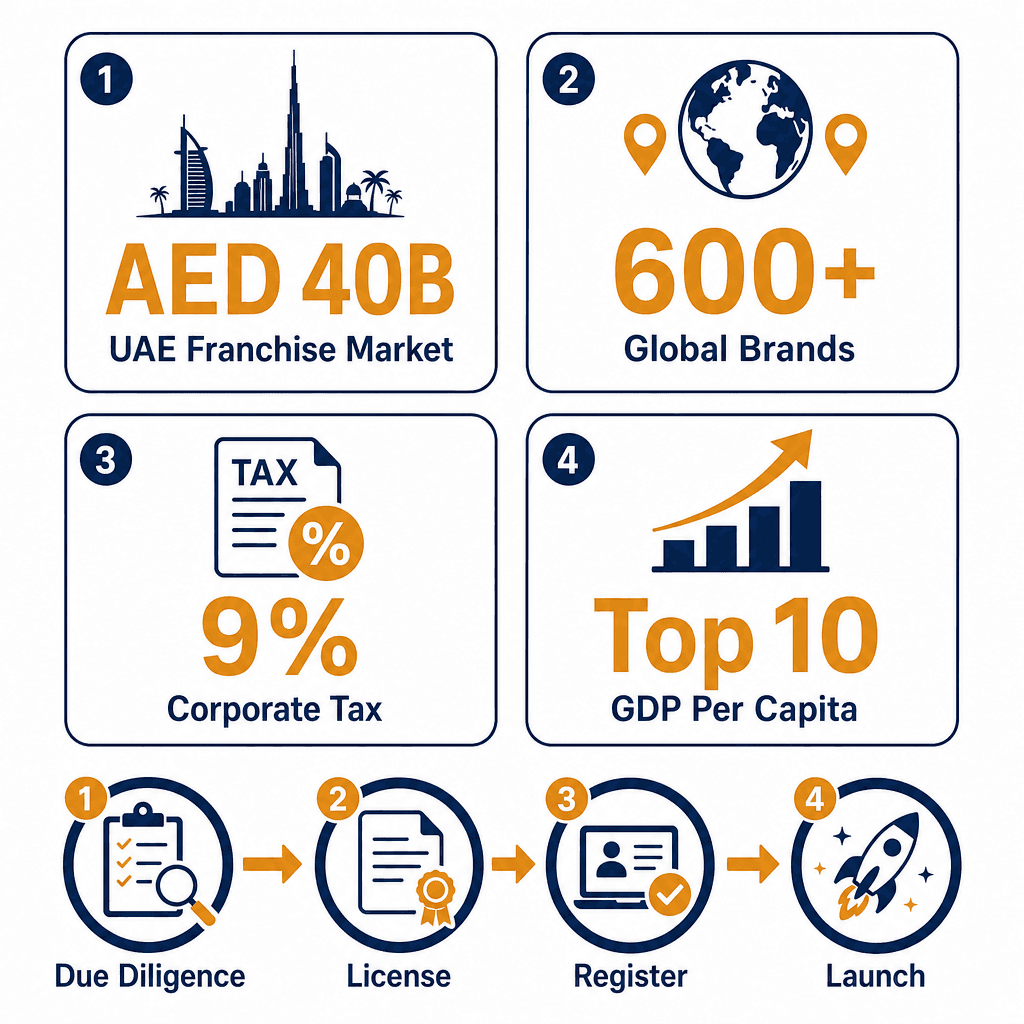
A franchise in Dubai is a licensed business arrangement where a franchisor grants a franchisee the right to operate under its brand, systems, and processes in exchange for fees and royalties. Dubai's stable economy, high consumer spending, and zero personal income tax make it one of the world's most attractive franchise markets. For investors who want to start franchise Dubai operations, the model offers a faster path to revenue than building a brand from scratch, you're buying a proven playbook, not writing one.
Master Franchise vs Sub-Franchise: Understanding the Two Entry Models
There are two ways to enter the Dubai franchise market as a buyer. A master franchisee purchases exclusive rights to develop a brand across the UAE or a defined territory, and can sub-license to operators beneath them. It's a higher capital commitment, but the upside is proportionally larger. Americana Group is the textbook example: they hold master franchise rights for KFC, Pizza Hut, and Hardee's across the GCC, controlling territory development and sub-licensing to individual operators.
A sub-franchisee buys the right to operate one or more outlets from the master franchisee. Entry costs are lower, but so is your control over brand direction and territory policy. Which model fits your situation depends on two things: available capital and appetite for operational complexity.
Master Franchise vs Sub-Franchise: Key Differences at a Glance
Feature | Master Franchisee | Sub-Franchisee |
|---|---|---|
Territory Rights | Exclusive rights across UAE or defined multi-emirate region | Single location or limited area granted by master franchisee |
Initial Investment | AED 500,000–AED 5 million+ depending on brand | AED 150,000–AED 1.5 million for a single outlet |
Royalty Flow | Pays royalty to franchisor; collects royalty from sub-franchisees | Pays royalty only to master franchisee |
Control Over Brand Standards | ✅ High, sets and enforces standards across the territory | ❌ Low, must follow standards set by master franchisee |
Right to Sub-License | ✅ Yes, can grant outlet licenses to sub-franchisees | ❌ No, operates only their own licensed outlet(s) |
Risk Level | Higher, responsible for territory development obligations | Lower, single-outlet operational risk only |
Upside Potential | ✅ Significant, income from own outlets plus sub-franchise royalties | Limited to single outlet profitability |
Why Dubai Attracts International and Regional Franchise Brands
The pull factors are concrete, not abstract. Zero personal income tax and a 9% corporate rate (well below the OECD average of 23%) make the P&L math work for franchise investors. The UAE's GDP per capita is consistently among the world's highest, which means consumers here spend more per visit than in most comparable markets. And the 4-hour flight radius that covers 2.5 billion consumers makes Dubai a natural regional hub for any brand wanting a Middle East footprint.
Key drivers drawing franchise brands to Dubai:
Zero personal income tax and competitive post-2023 corporate tax environment
High-income consumer base with strong discretionary spending
2.5 billion consumers within a 4-hour flight radius
Government-backed SME franchise support through Dubai SME
Growing homegrown ecosystem: Allo Beirut, Zaatar w Zeit, and regional F&B brands actively seeking franchisees
McDonald's, Starbucks, and Subway collectively operate hundreds of outlets across the UAE through established local franchise partners, proof that the model scales here when the fundamentals are right. And the homegrown side is catching up fast, with UAE-born brands now approaching their first master franchise agreements for GCC expansion.
What License Type You Need to Open a Franchise in Dubai
To open a franchise in Dubai, you typically need a commercial trading license for product-based franchises (retail, F&B) or a professional license for service-based franchises. The license is issued by Dubai Economy and Tourism (DET) for mainland operations, or by the relevant free zone authority if you're setting up in a free zone. Getting this right from day one matters: the wrong license type creates compliance problems and delays your opening.
Commercial Trading License for Product-Based Franchises
If you're opening an F&B outlet, a retail franchise, or any business selling physical goods, you need a commercial trading license. That means a Subway outlet, a GNC store, or a McDonald's restaurant all require a trading business license in Dubai with the correct commercial activity code matching the franchise's operations. DET issues these licenses within 3–5 working days for straightforward applications. Worth noting: some franchise agreements require submission to DET as part of the licensing process, so have your agreement ready before you apply.
Professional License for Service-Based Franchises
Education, fitness, consulting, and healthcare franchises fall under the professional license category. Think Kumon, Anytime Fitness, or Snap Fitness, these are knowledge and skill-based operations, and a professional business license in Dubai is the correct structure for them. Since the 2021 Foreign Direct Investment reforms, professional license holders can be 100% foreign-owned on the mainland, no local partner required.
Some professional franchises need additional regulatory sign-off before they can operate:
Education franchises: Knowledge and Human Development Authority (KHDA) approval
Healthcare and wellness: Dubai Health Authority (DHA) license
Fitness centres: DED activity code for sports/fitness services plus Dubai Sports Council registration in some cases
Trading License vs Professional License: Which Do You Need?
Feature | Trading License | Professional License |
|---|---|---|
Franchise Type | F&B, retail, physical goods | Education, fitness, consulting, healthcare |
Examples | Subway, GNC, McDonald's | Kumon, Anytime Fitness, Snap Fitness |
Foreign Ownership (Mainland) | ✅ 100% for most activities post-2021 | ✅ 100% foreign ownership |
Issuing Authority | Dubai Economy and Tourism (DET) | DET + sector regulator approval |
Additional Approvals | Dubai Municipality (F&B fit-out) | KHDA, DHA, or Dubai Sports Council |
Typical License Cost | AED 15,000–AED 50,000 | AED 12,000–AED 35,000 |
The Legal Framework for Franchising in the UAE
The UAE has no standalone franchise law. Franchise relationships are governed primarily by UAE Federal Commercial Agency Law No. 18 of 1981 (as amended) and general contract law under the Civil Code. Franchise agreements must be carefully drafted to protect both parties, particularly around territory rights, IP ownership, termination clauses, and royalty structures. This is one area where cutting corners on legal advice creates serious problems later.
How the Commercial Agency Law Affects Franchise Agreements
UAE Federal Law No. 18 of 1981 on Commercial Agency governs distribution and agency relationships, and many franchise structures fall within its scope. Here's the critical risk: if a franchise agreement is registered as a commercial agency under this law, the local agent gains significant protections, including the right to compensation on termination, regardless of cause or fault. That's a substantial exposure for any franchisor trying to exit a non-performing relationship.
International franchisors should carefully assess whether to register under the Commercial Agency Law or structure the agreement outside its scope. The DIFC (Dubai International Financial Centre) and ADGM (Abu Dhabi Global Market) both offer common law contract environments, many international franchisors prefer these jurisdictions as the governing law for their UAE franchise agreements, precisely to avoid Commercial Agency Law entanglement. General contract obligations in the absence of specific franchise legislation fall under UAE Civil Code (Federal Law No. 5 of 1985).
Protecting Your IP and Brand Before You Franchise
Trademark registration is non-negotiable before you franchise anything. Your brand name, logo, and trade dress must be registered with the UAE Ministry of Economy before you sign your first franchise agreement. A UAE-born café brand, for example, should register its trademark in Classes 30 and 43 (food products and restaurant services) before approaching any franchisee, because once you've signed an agreement without registered IP, you've handed your brand to someone you can't fully protect it from.
IP protection checklist before franchising:
Register trademark with UAE Ministry of Economy (valid 10 years, renewable, covers all seven Emirates)
Identify all relevant Nice Classification classes, register across every class your franchise touches
Include explicit IP licensing clauses, usage guidelines, and breach provisions in the franchise agreement
Consider simultaneous GCC trademark registration if regional expansion is the goal
For a detailed breakdown of costs and the registration process, see our guide on trademark registration in Dubai.
How to Buy a Franchise in Dubai: Due Diligence and Evaluating the Right Opportunity
Buying a franchise in Dubai requires rigorous due diligence: validating the franchisor's track record, understanding the full cost structure, scrutinising the franchise agreement, and confirming the brand's market fit with UAE consumer demographics. Skipping this process is the most common reason franchise investments underperform in the region. A franchise license in the UAE is straightforward to obtain, the hard part is making sure the underlying business model actually works in this market.
The Franchise Due Diligence Checklist Every Buyer Needs
Before you commit to any franchise, work through this checklist:
Franchisor track record: How many outlets are operating globally and in the region? What's the failure rate? Average franchisee tenure?
Franchise Disclosure Document (FDD): Not legally mandated in the UAE, but international franchisors often provide one. Request it. If they won't share it, that tells you something.
Territory exclusivity: Is your territory clearly defined in the agreement? What prevents the franchisor from opening nearby company-owned outlets?
Training and ongoing support: What does the franchisor actually deliver post-launch, versus what's promised in the sales pitch?
Talk to existing franchisees: This is the most valuable step. A prospective Subway sub-franchisee in Dubai should be speaking directly to existing UAE operators about monthly revenue, occupancy costs, and royalty burden before committing.
Agreement term: Franchise agreements in the UAE typically run 5–10 years with renewal options, understand what renewal costs and whether terms can change.
Understanding the Franchise Agreement: Key Clauses to Scrutinise
A franchise agreement for a regional F&B brand might specify 6% royalty on gross sales plus a 2% marketing levy. Before signing, a smart buyer models that against realistic monthly revenue projections to confirm the unit economics actually work. Key clauses to examine:
Royalty structure: Typically 4–8% of gross revenue; some brands charge a flat monthly fee instead
Marketing levy: Usually 1–4% of gross revenue into a shared fund, confirm how those funds are allocated and who controls spending decisions
Territory rights: What constitutes a breach of territory, and what's the remedy?
Termination clauses: What triggers termination, what are the notice periods, and does the franchisee have any right of appeal?
Renewal terms: Does renewal cost money? Can the franchisor impose new conditions at renewal?
What should I look for in a UAE franchise agreement?
Focus on five things: territory exclusivity, royalty and marketing levy rates (4–8% and 1–4% of gross revenue respectively are market standard), termination triggers and notice periods, IP ownership and usage rights, and renewal conditions including any fee changes. Get a UAE-qualified lawyer to review the agreement before you sign.
Franchise Costs in Dubai: What You'll Actually Pay to Start Franchise Dubai Operations
Starting a franchise in Dubai involves five main cost categories: the initial franchise fee (AED 50,000–AED 500,000+), fit-out and equipment costs, the trade license and setup fees, working capital for the first 3–6 months, and ongoing royalties. Total investment for a mid-market F&B franchise typically ranges from AED 500,000 to AED 1.5 million. To open a franchise in Dubai with realistic expectations, you need to model all five before you sign anything.
5 Cost Categories Every Franchise Buyer in Dubai Must Budget For
Initial franchise fee, AED 50,000 to AED 500,000+: Paid to the franchisor for the right to use their brand and systems. Smaller regional brands sit at the lower end; premium international brands can exceed AED 500,000.
Fit-out and equipment, AED 300,000 to AED 1.2 million: The largest single cost for F&B and retail franchises. Brand standards are non-negotiable, and fit-out costs vary significantly by outlet size and location.
Trade license and setup fees, AED 15,000 to AED 50,000: Mainland DET license or free zone license, depending on your structure and activity.
Working capital, AED 100,000 to AED 300,000: Budget for 3–6 months of operating expenses before the business reaches break-even. Most buyers underestimate this.
Ongoing royalties and marketing levies: Factor 4–8% royalty plus 1–4% marketing levy into your monthly P&L model from day one, these are permanent costs, not launch costs.
A worked example: a mid-market café franchise in Dubai with a AED 150,000 franchise fee, AED 600,000 fit-out, AED 25,000 license, and AED 200,000 working capital lands at AED 975,000 total initial investment before the first customer walks in. Use the business setup cost calculator to model your own numbers before committing.
Free Zone vs Mainland: Which Setup Is Right for Your Franchise?
If your franchise will operate retail outlets, restaurants, or any customer-facing business across Dubai, you need a mainland license, you can't trade directly with the UAE public on a free zone license alone. But free zones serve a real purpose in franchise structures. They're ideal
References
[1] Source pending — please add URL and publisher.
[2] Source pending — please add URL and publisher.
[3] Source pending — please add URL and publisher.
[4] Source pending — please add URL and publisher.
[5] Source pending — please add URL and publisher.