
UAE bankruptcy law offers three formal procedures: preventive composition, restructuring, and bankruptcy with liquidation. Either the debtor or creditors owed AED 100,000 or more can petition the court to open proceedings. Acting early gives founders access to restructuring rather than forced liquidation, and the law provides protection from creditor enforcement once a procedure opens.
Roughly 90% of startups globally fail within their first five years (CB Insights, 2024). The UAE registers over 40,000 new businesses annually (Dubai Chamber, 2023). Federal Law No. 9 of 2016 came into force in December 2016, replacing criminal exposure with structured procedures. Amendments followed in 2019 and 2020. The UAE has 45+ free zones, each with its own regulatory authority. DIFC Courts enforce judgments in 160+ countries. What has changed dramatically for founders is the legal safety net available when a Dubai startup hits a financial wall.
This guide covers the UAE Bankruptcy Law framework, what it means for your personal liability as a founder, what happens to employees and government registrations when a company becomes insolvent, early warning signs to watch for, and the separate insolvency rules that apply if your startup is based in the DIFC. By the end, you'll know your options well before you ever need them.
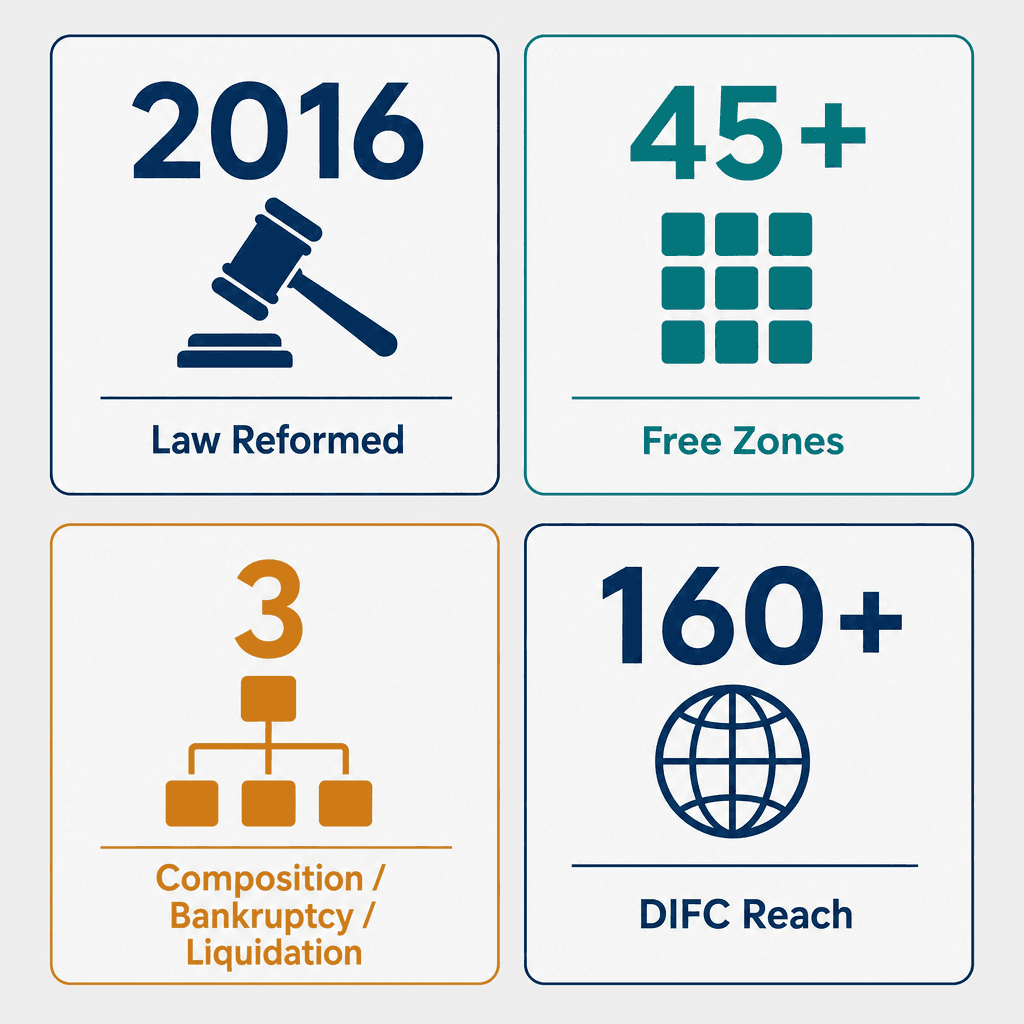
UAE Startup Bankruptcy: Key Numbers 2016 Federal Law No. 9 enacted, ending criminal exposure UAE Ministry of Justice 45+ Free zones, each with its own winding-up rules UAE Government, 2026 3 Formal procedures: Composition, Bankruptcy, Liquidation Federal Law No. 9, 2016 160+ Countries where DIFC judgments are enforceable DIFC Courts, 2024
Key figures for startup founders navigating UAE insolvency law, sourced from UAE Ministry of Justice, UAE Government portal, and DIFC Courts (2024-2026).
What Is UAE Bankruptcy Law and Who It Covers
UAE Bankruptcy Law (Federal Law No. 9 of 2016, amended in 2019 and 2020) is the primary legal framework governing financial restructuring and formal insolvency for companies operating on the UAE mainland. It applies to traders and commercial entities registered under UAE commercial law, offering structured procedures to manage debt before or during insolvency.
The Evolution from Criminalisation to Commercial Realism
Before 2016, a UAE founder whose company failed could face criminal liability under the old Commercial Transactions Law. That wasn't a theoretical risk, it was a real deterrent that pushed struggling founders to flee rather than restructure. Federal Law No. 9 of 2016 changed that calculus entirely, shifting the framework toward a model that protects both creditors and debtors in a commercially rational way.
The timeline matters here:
December 2016: Federal Law No. 9 of 2016 comes into force
2019: Federal Decree-Law No. 11 of 2019 streamlines procedures
2020: Further amendments introduce specific SME protections
A SaaS startup registered on the Dubai mainland that ran out of runway in 2024 can now engage formal restructuring without its founder facing automatic criminal exposure. That's a stark contrast to what founders dealt with before 2016, and it's why startup bankruptcy Dubai conversations have become far less frightening in recent years.
Which Entities Are Covered, and Which Are Not
The law covers mainland UAE companies: LLCs (Limited Liability Companies), PJSCs (Public Joint Stock Companies), and sole establishments registered as traders. Financial institutions, banks and insurance companies, are excluded, falling under separate Central Bank and Insurance Authority regulation.
Free zone companies are a different matter entirely. A fintech startup incorporated as an LLC in a Dubai free zone (not DIFC or ADGM) would typically follow that free zone's own cancellation and winding-up rules, which may or may not mirror the federal bankruptcy procedures. The UAE has 45+ free zones, each with its own regulatory authority (UAE Government Portal, 2026). DIFC and ADGM are unique in operating under English common law-based insolvency frameworks, more on that in a later section.
If you're a founder in a free zone, check your specific authority's winding-up procedures before assuming federal law applies. For more on liquidating a free zone company in Dubai, the process differs meaningfully from mainland procedures.
The Three Formal Procedures Available Under UAE Bankruptcy Law
UAE Bankruptcy Law provides three main procedures: Preventive Composition (restructuring before formal insolvency, initiated by the debtor), Bankruptcy (formal court-supervised insolvency for companies unable to pay debts), and Liquidation (court-ordered winding up and asset distribution to creditors). Each serves a different stage of financial distress.
UAE Bankruptcy Procedures: Which Applies to Your Situation
Feature | Preventive Composition | Formal Bankruptcy | Liquidation |
|---|---|---|---|
When to use | Before insolvency, foresees inability to pay | Company cannot pay debts as they fall due | No viable restructuring plan exists |
Who initiates | Debtor only | Debtor or creditors (AED 100,000+ owed) | Court order after bankruptcy |
Can company keep trading? | ‚úÖ Yes, during restructuring | ‚úÖ Possible under restructuring plan | ‚ùå No, assets sold |
Creditor enforcement stayed? | ‚úÖ Yes | ‚úÖ Yes | ‚ùå Managed by trustee |
Typical timeline | 6-18 months | 12-36 months | 12-36 months |
Filing deadline | Before 30 business days in default | Within 30 days of insolvency trigger | Court-ordered |
Preventive Composition: Restructuring Before Insolvency
Preventive Composition is the tool most founders don't know they have. It's available before a company is technically insolvent, specifically, it must be filed before the company is more than 30 business days in default on a material payment. The debtor files with the competent court, submitting financial statements, a creditor list, and a proposed restructuring plan.
A court-appointed trustee then assists in negotiating the plan with creditors. Approval requires a majority of creditors by both number and value. Critically, enforcement actions by creditors are stayed during the process, giving the company breathing room to restructure without a creditor race to seize assets.
A Dubai-based e-commerce startup burning through cash after a supply chain collapse could file for Preventive Composition, propose a 24-month debt repayment schedule, and continue trading throughout, rather than folding immediately. If the plan fails, the court can convert proceedings to formal bankruptcy.
Formal Bankruptcy and Liquidation: What Court-Supervised Insolvency Looks Like
Formal bankruptcy proceedings begin when a company can't pay its debts as they fall due. Either the debtor or creditors owed AED 100,000 or more can petition the court to open proceedings (Federal Law No. 9 of 2016, UAE Ministry of Justice). A court-appointed trustee takes control of assets, verifies creditor claims, and manages the process.
If restructuring within bankruptcy isn't viable, the court orders liquidation. Asset sale proceeds are distributed in this priority order:
Secured creditors (against pledged assets)
Employees (unpaid wages and end-of-service gratuity)
Unsecured creditors (pro-rata)
Shareholders (if anything remains)
Abraaj Group, while not a startup, demonstrated how UAE court-supervised insolvency can handle complex multi-creditor situations, with liquidators appointed to manage asset recovery across multiple jurisdictions. The World Bank estimates UAE insolvency resolution averages approximately 2.9 years, a figure that has improved with each reform cycle (World Bank Doing Business, 2024).
UAE Bankruptcy Procedures: A Visual Comparison
A side-by-side flowchart showing the three UAE bankruptcy procedures and when each applies, designed for startup founders assessing their options.
Preventive Composition: Pre-insolvency, debtor-initiated, creditor enforcement stayed, company continues trading
Formal Bankruptcy: Post-insolvency trigger, debtor or creditor-initiated, AED 100,000 creditor threshold
Liquidation: Court-ordered, assets sold, priority payout order: secured creditors, employees, unsecured creditors
Filing deadline for Preventive Composition: within 30 business days of first material default
Typical resolution timeline: 12-36 months for bankruptcy and liquidation (World Bank, 2024)
DIFC and ADGM: separate frameworks, not subject to Federal Law No. 9 of 2016
Suggested alt text: Flowchart comparing UAE Preventive Composition, Formal Bankruptcy, and Liquidation procedures under Federal Law No. 9 of 2016, showing triggers, timelines, and creditor priority order.
Personal Liability for Founders: What UAE Law Actually Says
In a UAE free zone LLC or FZE (Free Zone Establishment), shareholders are generally not personally liable for company debts beyond their invested share capital. A company's insolvency does not automatically expose founders to personal financial liability, unless fraud, gross negligence, or personal guarantees are involved. This is a critical protection for anyone navigating startup bankruptcy Dubai scenarios.
Limited Liability: The Structural Protection Founders Rely On
An LLC or FZE limits each shareholder's liability to the value of their share capital contribution. If a startup with AED 50,000 in share capital fails with AED 2 million in debts, the founder's personal assets, property, savings, personal accounts, are not automatically at risk. This is codified under UAE Commercial Companies Law (Federal Decree-Law No. 32 of 2021) and most free zone regulations.
A founder who invested AED 10,000 as share capital in a Dubai South free zone FZE is exposed only to that AED 10,000 if the company becomes insolvent, not to the company's total creditor claims. Sole traders and sole proprietorships don't carry this protection, which is a fundamental reason founders choose incorporated structures. If you're still deciding on your structure, explore options to launch your company at Dubai South Business Hub Free Zone.
When Personal Liability Can Pierce the Corporate Veil
The limited liability shield isn't absolute. Here's when it breaks down:
Personal guarantees: If you personally guaranteed a bank loan or supplier contract, that guarantee is enforceable against you personally regardless of company insolvency. A founder who personally guaranteed a AED 500,000 bank facility to secure working capital remains personally liable for that sum even after the company enters formal bankruptcy proceedings.
Fraud or misrepresentation: Concealing assets, falsifying accounts, or trading while knowingly insolvent to the detriment of creditors can result in courts imposing personal liability.
Director misconduct: Wrongful trading or preferential payments to connected parties before insolvency can expose directors to personal claims.
Personal guarantees are standard practice for SME bank lending in the UAE. Audit every agreement you've signed in a personal capacity, not just documents signed as a company representative. That's where the real exposure often hides.
Is a UAE founder personally liable for company debts?
In a UAE LLC or FZE, a founder's personal liability is generally capped at their share capital contribution. Personal assets are protected unless the founder provided personal guarantees, committed fraud, or engaged in wrongful trading. This protection is codified under Federal Decree-Law No. 32 of 2021.
What Happens to Employees and Trade Licenses When a Startup Becomes Insolvent
When a UAE startup becomes insolvent, employees are priority creditors for unpaid wages and end-of-service gratuity, they are paid before unsecured creditors from liquidated assets. Trade licenses and government registrations must be formally cancelled through the relevant authority; simply ceasing operations without cancellation creates ongoing legal and financial obligations.
Employee Visa Cancellation and End-of-Service Obligations
Under UAE Labour Law (Federal Decree-Law No. 33 of 2021), employees are entitled to end-of-service gratuity calculated on basic salary: 21 days' basic salary per year for the first five years, then 30 days per year thereafter. In insolvency proceedings, these claims rank as priority, employees are paid ahead of most unsecured creditors.
The UAE Wage Protection System (WPS) gives authorities real-time visibility into wage arrears. Non-payment triggers regulatory action separately from insolvency proceedings, meaning a company can face WPS enforcement even while bankruptcy proceedings are ongoing. Employee visas must be formally cancelled through the General Directorate of Residency and Foreigners Affairs (GDRFA). Failure to cancel leaves the company and its officers exposed to fines and immigration violations.
A Dubai tech startup with 12 employees entering liquidation must cancel all 12 employee visas, settle WPS wage obligations (or formally acknowledge them as creditor claims), and include gratuity entitlements in the creditor claim schedule. None of this happens automatically.
Formally Cancelling Your Trade License and Government Registrations
A UAE trade license does not lapse automatically when a company stops trading. It must be formally cancelled through the relevant licensing authority, the DED (Dubai Department of Economic Development) for mainland companies, or the free zone authority for free zone companies. Failing to cancel means license renewal fees, fines, and government charges continue to accrue.
One founder who locked the office and stopped paying rent without formally cancelling the trade license later discovered AED 30,000+ in accumulated renewal fees and government fines, all legally enforceable against the company. VAT registration (if applicable) must also be cancelled with the Federal Tax Authority (FTA) within 20 business days of cessation of taxable supplies (FTA, 2024). For a step-by-step guide, see cancelling a trade license in Dubai. Staying on top of these obligations is exactly what a company compliance calendar UAE is designed for.
Five Early Warning Signs Your Dubai Startup Is in Financial Distress
Early warning signs of financial distress in a UAE startup include persistent cash flow shortfalls, inability to meet payroll, creditor demands escalating to legal threats, reliance on short-term debt to fund operating costs, and deteriorating creditor payment terms. Acting early, before formal insolvency, gives founders far more options and negotiating power under UAE insolvency law.
Recognising the Warning Signs Before They Become a Crisis
Persistent negative operating cash flow for three or more consecutive months, revenue isn't covering operating costs even before debt service kicks in.
Payroll delays or founder-funded salaries, drawing on personal savings to cover payroll is a structural red flag, not a temporary timing issue.
Deteriorating creditor terms, suppliers demanding upfront payment, credit lines being withdrawn, or bank facilities being called in early.
Legal demand letters or court notices, once creditors escalate to legal action, the window for informal resolution narrows fast.
Using new debt to service existing debt, overdrafts, short-term loans, or director loans used to make interest payments is a classic indicator of approaching insolvency UAE.
A Dubai logistics startup that began drawing on its founder's personal savings to cover payroll in month four of a cash crunch had a clear early warning signal, but waited six more months before engaging a restructuring adviser. By that point, creditor options had narrowed significantly and the cost of resolution had multiplied.
Practical Steps to Take Before Formal Insolvency Proceedings
Engage a licensed restructuring adviser early. They can assess whether Preventive Composition or informal creditor negotiation is viable, and the earlier they're involved, the more options remain open.
Open communication with key creditors. Banks and major suppliers often prefer a negotiated repayment plan over formal insolvency, which recovers less for everyone.
Explore refinancing options. UAE government-backed SME support schemes, including those administered by the Emirates Development Bank, offer emergency working capital facilities for qualifying businesses.
Review all contracts for insolvency trigger clauses. Change of control, acceleration, or cross-default clauses can create cascading liability if not managed proactively.
Stay current on compliance obligations. Outstanding filings and renewals create additional liability during an already-stressful period.
In 2020, several UAE hospitality startups hit by pandemic restrictions successfully negotiated informal debt standstills with landlords and suppliers before any formal insolvency filing, preserving relationships and buying time to restructure. The UAE introduced emergency economic support measures that year, including SME debt relief programmes, demonstrating that the regulatory environment can flex during systemic shocks. For ongoing support, Dubai South Business Hub business support services can help you assess your position before it becomes a crisis.
What should a UAE startup founder do first when facing insolvency?
Engage a licensed restructuring adviser before creditors
Useful Resources
UAE corporate tax explained