
Table of Contents What is a Holding Company in Dubai Why Set Up a Holding Company in UAE Holding Company Structures in UAE Free Zone Holding Company vs DIFC vs Offshore Holding Company and UAE Corporate Tax Setup…
Table of Contents
What is a Holding Company in Dubai
Why Set Up a Holding Company in UAE
Holding Company Structures in UAE
Free Zone Holding Company vs DIFC vs Offshore
Holding Company and UAE Corporate Tax
Setup Process and Costs
When a Holding Company Makes Sense
How Dubai South Business Hub Free Zone Helps
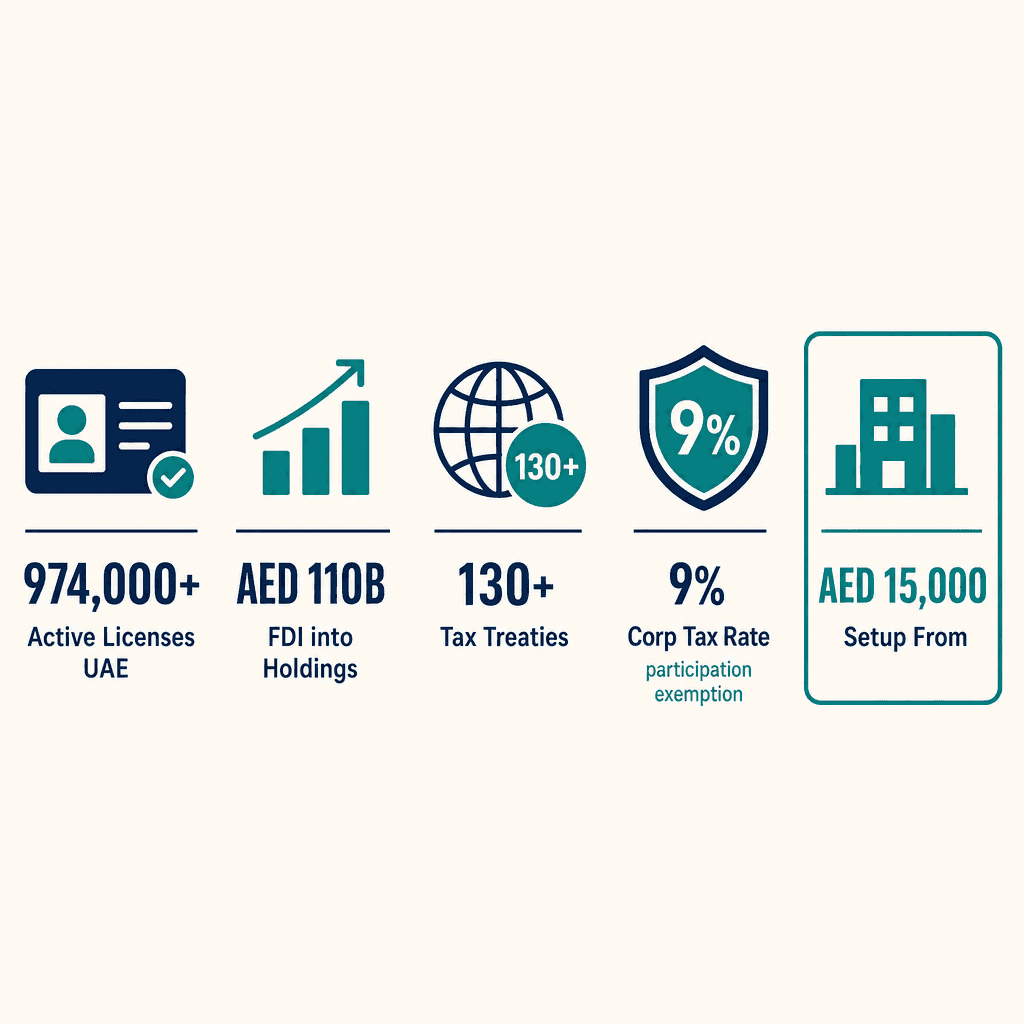
In 2026, the UAE Ministry of Economy recorded over 974,000 active commercial licenses across the country, with holding company registrations in free zones rising 18% year-on-year (UAE Ministry of Economy, 2026). Foreign direct investment into UAE holding structures topped AED 110 billion in the same period (UAE Central Bank, 2026). The UAE maintains double tax treaties with 130+ countries (Ministry of Finance, 2026), and the 9% corporate tax rate introduced in June 2023 includes a participation exemption that effectively shields qualifying holding income from tax entirely (Federal Tax Authority, 2023). Setup costs for a holding company in Dubai start from AED 15,000 at Dubai South Business Hub Free Zone, making it one of the most cost-efficient group structuring jurisdictions globally.
A holding company in Dubai is a legal entity that owns shares in one or more subsidiary companies rather than trading directly. This guide covers license types, approved structures, free zone versus DIFC versus offshore options, UAE corporate tax interaction, 2026 setup costs in AED, and a step-by-step process, so you can decide which structure fits your business group. Ready to get started? Launch your company at Dubai South Business Hub Free Zone today.
What is a Holding Company in Dubai
A holding company in Dubai is a parent entity incorporated to own shares, intellectual property, or assets in subsidiary companies. It does not trade directly. Instead, it holds equity stakes, manages investments, and provides centralised governance across a group of operating businesses registered in the UAE or internationally.
Definition and Legal Basis
A holding company UAE derives its income from dividends, capital gains, royalties, and intra-company loans, not from direct sales of goods or services. UAE Commercial Companies Law (Federal Decree-Law No. 32 of 2021) formally recognises holding company structures for both mainland and free zone entities, giving the structure clear legal standing under UAE statute (UAE Ministry of Economy, 2021).
The holding company itself holds a commercial license, but its permitted activities are limited to ownership and management of subsidiaries. It does not engage in operational trading. A practical illustration: a Dubai-based entrepreneur owns a logistics firm, a staffing agency, and a real estate portfolio. A single holding company Dubai sits above all three, simplifying ownership, governance, and profit repatriation without complicating each subsidiary's day-to-day operations. Holding companies can own 100% of free zone subsidiaries without restriction under the same 2021 law.
What a Holding Company Can and Cannot Do
The distinction between permitted and restricted activities matters enormously for UAE corporate tax purposes. Mixing operational and holding activities in one entity can disqualify qualifying income exemptions.
Permitted activities include:
Holding shares in subsidiaries
Managing group investments
Licensing intellectual property to subsidiaries (intra-group IP licensing)
Providing intra-group loans
Receiving dividends and capital gains
Restricted activities include:
Direct retail or wholesale trading
Providing services to third-party clients outside the group
Employing operational staff for external projects
Worth flagging: ancillary activities such as internal accounting and treasury management are absorbed into the holding company's principal activity classification and do not require a separate license. This aligns with the ISIC Rev.4 principle that ancillary activities supporting the main unit are not separately classified (ISIC Rev.4, 2008). For a full breakdown of the tax interaction, see UAE corporate tax explained.
Why Set Up a Holding Company in UAE
Setting up a holding company in UAE gives business owners asset protection, tax efficiency, simplified group governance, and a credible international structure. The UAE's 0% personal income tax, extensive double tax treaty network covering 130+ countries, and 9% corporate tax with qualifying income exemptions make it one of the world's most attractive holding jurisdictions.
Asset Protection and Risk Separation
Liabilities of an operating subsidiary cannot pierce the holding company's assets. If one subsidiary faces a legal claim or insolvency, the parent entity and other subsidiaries are insulated. UAE courts recognise the corporate veil principle, reinforcing separation between holding and subsidiary entities under Federal Decree-Law No. 32 of 2021.
Intellectual property, real estate, and investment portfolios held at holding company level are ringfenced from operational risk. This structure is particularly valuable for entrepreneurs in regulated sectors. A healthcare group, for example, might use a holding company Dubai structure to separate clinic operations (with their regulatory and liability exposure) from the IP portfolio and property assets, ensuring a malpractice claim against one clinic cannot threaten the group's broader asset base. Individual shareholders also pay 0% personal income tax on dividends received from a UAE holding company (UAE Ministry of Finance, 2026).
Tax Efficiency and Profit Repatriation
Dividends paid from UAE subsidiaries to a UAE holding company are generally exempt from the 9% corporate tax under the participation exemption. Capital gains on the disposal of subsidiary shares qualify for the same exemption, provided the holding company owns at least 5% of the subsidiary for at least 12 months (Federal Tax Authority, 2023).
Profits can be consolidated and reinvested across the group from a single entity, reducing the need for costly cross-border transfers. An investor holding three UAE subsidiaries, for instance, receives tax-exempt dividends at holding level and redeploys capital into a fourth acquisition without triggering additional tax at the holding tier. For a deeper breakdown, see UAE corporate tax explained.
Holding Company Structures in UAE
UAE holding companies can be structured as a mainland LLC or PJSC under DET jurisdiction, a free zone holding company under a specific free zone authority, a DIFC or ADGM entity under common law frameworks, or a Jebel Ali offshore company. Each Dubai holding company structure suits different asset types, investor profiles, and tax objectives.
Mainland Holding Company
A mainland holding company license UAE is registered with the Department of Economy and Tourism (DET, formerly DED) as an LLC or PJSC. It can own both mainland and free zone subsidiaries directly, giving it the broadest operational reach of any structure. DET mainland license renewal typically costs AED 10,000–20,000 per year depending on activity type.
The 2021 Companies Law removed the mandatory 51% UAE national ownership requirement for most commercial sectors, making the mainland a genuinely accessible option for foreign investors. A mainland LLC holding company owning a DET-licensed trading company and a RERA-registered property portfolio is a common structure for groups with UAE real estate exposure, since RERA-registered properties are most cleanly held through a mainland entity.
Free Zone Holding Company
A free zone holding company Dubai is incorporated under a free zone authority such as DMCC, JAFZA, DIFC, Dubai South, or RAK ICC. You get 100% foreign ownership with no UAE national shareholder requirement. Over 40 active free zones operate in the UAE (UAE Ministry of Economy, 2026), each with its own fee schedule and activity list.
Free zone holding companies can own other free zone entities directly. Owning mainland companies requires a branch or service agent arrangement, a structural consideration worth planning for at the outset. A DMCC-registered holding company owning two JAFZA subsidiaries and one DIFC-regulated entity is a real-world example of this cross-free-zone ownership model. Free zone qualifying persons may also benefit from 0% tax on qualifying income under UAE corporate tax rules, which we cover in the tax section below. Launch your company at Dubai South Business Hub Free Zone to explore free zone holding options.
Free Zone Holding Company vs DIFC vs Offshore
A standard free zone holding company suits most SME group structures at lower cost. DIFC and ADGM offer common law frameworks ideal for regulated financial holdings and international investors requiring English-law contracts. An offshore holding company UAE (RAK ICC or Jebel Ali) provides maximum privacy and minimal cost but cannot hold a UAE trade license or open a local bank account.
UAE Holding Company Jurisdiction Comparison 2026
Jurisdiction | License Fee (AED) | Registration Fee (AED) | Annual Renewal (AED) | Timeline | Best For |
|---|---|---|---|---|---|
Dubai South Business Hub Free Zone | 15,000 | 3,000 | 15,000 | 5–7 days | SME group holding, investment holding |
DMCC | 18,000 | 5,000 | 18,000 | 7–10 days | Commodities, multi-sector groups |
DIFC | 50,000 | 10,000 | 50,000 | 10–15 days | Financial holdings, family offices, PE funds |
DET Mainland LLC | 12,000 | 8,000 | 12,000 | 15–25 days | Mainland-linked asset holding, RERA property portfolios |
RAK ICC Offshore | 8,000 | 2,000 | 8,000 | 3–5 days | IP holding, international investment, privacy |
When to Choose DIFC or ADGM
DIFC is governed by English common law, essential for international investors who need enforceable English-law contracts and access to the DIFC Courts. With over 6,000 registered entities (DIFC Authority, 2026) and more than 2,500 cases handled by the DIFC Courts in 2025, it's a genuinely mature legal ecosystem. A private equity fund manager using a DIFC holding entity to own portfolio companies across the GCC benefits from that legal certainty in ways a standard free zone structure can't replicate.
ADGM in Abu Dhabi mirrors this framework and is preferred for Abu Dhabi-based family offices and asset managers. Both jurisdictions require higher minimum capital and more complex compliance than standard free zones. For straightforward SME holding company UAE structures, the cost premium is rarely justified. Calculate your setup cost to compare options side by side.
Holding Company and UAE Corporate Tax
UAE corporate tax applies at 9% on taxable income above AED 375,000 from June 2023. Holding companies in UAE benefit from the participation exemption on dividends and capital gains from qualifying subsidiaries. Free zone holding companies that meet Qualifying Free Zone Person criteria may pay 0% on qualifying income, making the UAE one of the world's most tax-efficient holding jurisdictions.
Participation Exemption Explained
Dividends received by a UAE holding company from a subsidiary are exempt from 9% corporate tax if the holding company owns at least 5% of the subsidiary and has held those shares for at least 12 months (UAE CT Law, 2023). Capital gains on disposal of subsidiary shares qualify under the same conditions. This prevents economic double taxation: profits taxed at subsidiary level are not taxed again when distributed upward to the holding company.
The exemption applies to both UAE-resident subsidiaries and qualifying foreign subsidiaries. A UAE holding company Dubai receiving an AED 5 million dividend from a subsidiary pays 0% tax on that income under the participation exemption, a direct AED 450,000 saving versus a standard 9% charge. That's the structural advantage in concrete terms.
Qualifying Free Zone Person Status
A free zone holding company UAE can maintain 0% tax on qualifying income if it meets Qualifying Free Zone Person (QFZP) criteria set by the Federal Tax Authority. Qualifying income includes dividends from subsidiaries, capital gains on shares, and certain intra-group service income. Non-qualifying income, for example, income earned directly from mainland UAE customers, is taxed at 9%.
Mixing operational and holding activities in one entity risks losing QFZP status entirely. A Dubai South Business Hub Free Zone holding company that keeps all operational income in a separate subsidiary, for instance, preserves its QFZP status cleanly. QFZP status also requires adequate economic substance in the free zone (FTA, 2023), meaning you need a real registered presence, not just a postal address. For a complete breakdown, see UAE corporate tax explained.
Is a holding company in Dubai subject to VAT?
A pure holding company that only receives dividends and capital gains is generally outside the scope of UAE VAT, since these are not considered supplies of goods or services. If the holding company charges management fees or provides services to subsidiaries, those fees may be subject to 5% VAT and require VAT registration above the AED 375,000 threshold (Federal Tax Authority, 2023).
Setup Process and Costs
Setting up a holding company in Dubai takes 5–10 working days in a free zone and 15–25 working days on the mainland. Total costs range from AED 15,000 for a basic free zone holding company license UAE to AED 60,000+ for a DIFC structure. Here's exactly how the process works.
stepsh2> Step-by-Step: How to Set Up a Holding Company in Dubai
Define your holding structure. Decide which jurisdiction (free zone, mainland, DIFC, or offshore), which subsidiaries will be held, and what assets or IP will sit at holding level. This structural planning step saves significant cost and restructuring effort later.
Reserve your company name. Submit name options to the chosen free zone authority or DET. Approval typically takes 1–2 working days.
Prepare incorporation documents. You'll need a Memorandum of Association, shareholder passport copies, proof of address, and a board resolution if a corporate shareholder is involved.
Submit your application and pay license fees. Submit via the free zone authority's portal or DET online. Pay the license fee at this stage (see cost table below).
Receive your license and certificate of incorporation. Free zone holding licenses issue within 3–5 working days of document approval. An entrepreneur registering at Dubai South Business Hub Free Zone can realistically complete the entire process in 7 working days. Register for corporate tax within 3 months of license issuance (FTA, 2023).
References
UAE Ministry of Economy (economy.gov.ae)
DIFC Authority (difc.ae)