G the step-by-step process, costs in AED, required documents and timelines. It compares the available options so you can make an informed decision about the right structure for your business. Dubai South Business Hub Free Zone offers packages starting from AED 12,500 with same-day licence issuance.
In 2026, bilateral trade between Turkey and the UAE exceeded AED 55 billion, placing Turkey among the UAE's top ten trading partners (UAE Ministry of Economy, 2026). Over 18,000 Turkish-owned businesses are now registered across Dubai's free zones and mainland, a figure that climbed 22% year-on-year (Dubai Chamber of Commerce, 2026). Turkish entrepreneurs in Dubai can register a company with 100% foreign ownership from AED 12,500, with licensing completed in as little as three to five working days through a free zone. The Turkey-UAE Double Taxation Avoidance Agreement (DTAA), signed in 1994, remains active, and the UAE's 9% corporate tax applies only on profits above AED 375,000, meaning most early-stage Turkish SMEs pay zero. This guide covers everything you need: ownership rights, required documents, the tax treaty, setup costs in AED, and how to plug into Dubai's active Turkish business community. Launch your company at Dubai South Business Hub Free Zone and join this growing community today.
Turkish Entrepreneurs in Dubai - Key Stats 2026 18,000+ Turkish-owned businesses Dubai Chamber, 2026 AED 55B Turkey-UAE bilateral trade UAE Ministry of Economy, 2026 22% YoY growth in registrations Dubai Chamber, 2026 AED 12,500 Free zone setup from Dubai South BH FZ, 2026
Turkish Entrepreneurs in Dubai - Growing Community
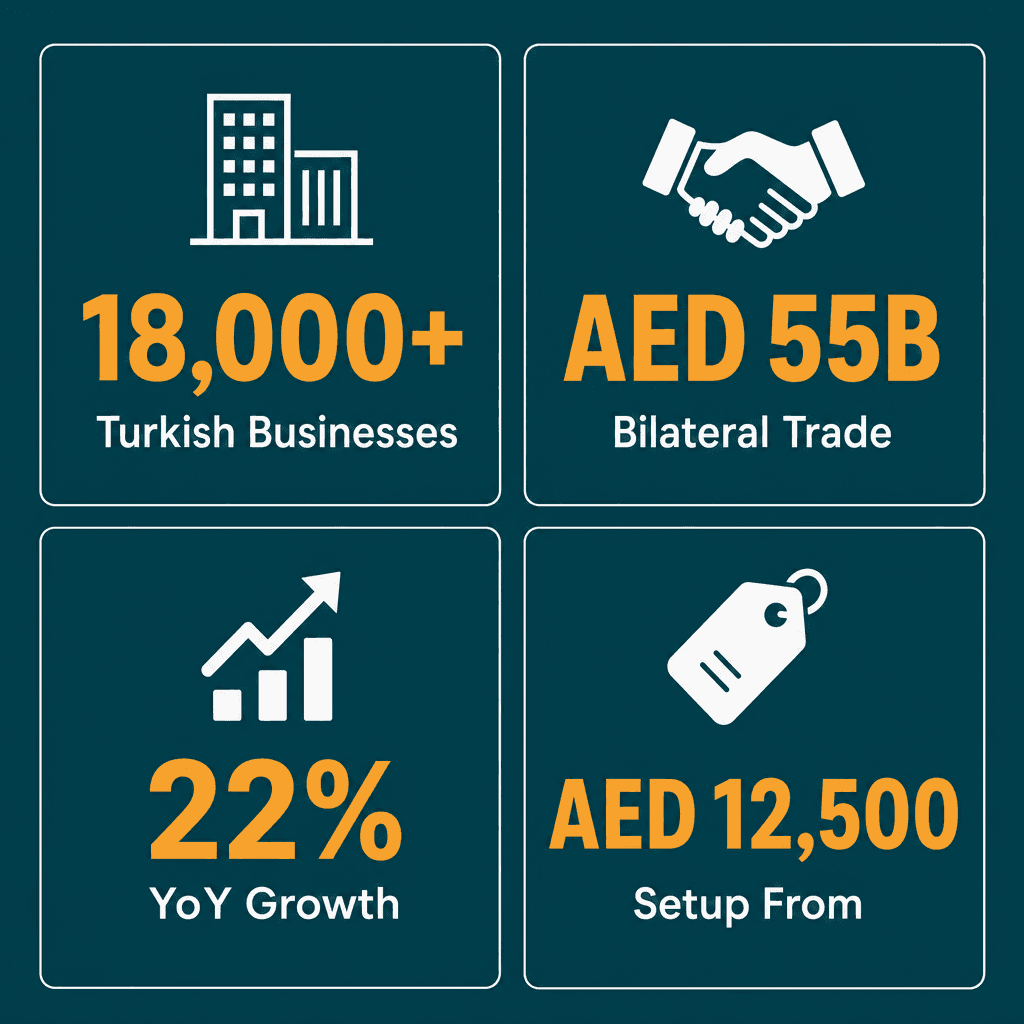
Turkish entrepreneurs in Dubai form one of the city's fastest-growing expatriate business communities, with over 18,000 Turkish-owned businesses registered as of 2026 (Dubai Chamber of Commerce, 2026). Bilateral trade between Turkey and the UAE exceeded AED 55 billion, creating strong demand for Turkish-run trading, manufacturing, and professional services firms in Dubai.
Why Turkish Nationals Are Choosing Dubai in 2026
The financial case is straightforward. Dubai charges zero personal income tax, while Turkey's progressive income tax reaches up to 40% on higher earners. That's a significant difference for any founder paying themselves a salary from their business.
Currency risk is another major driver. Turkish business owners in UAE increasingly invoice in AED or USD, providing a natural hedge against Turkish Lira (TRY) volatility. A Turkish textile exporter who registered at Dubai South Business Hub Free Zone in 2025 now invoices European clients in EUR and converts to AED, bypassing TRY exposure entirely.
Geographically, Dubai is a four-hour flight from Istanbul. That proximity lets Turkish founders genuinely manage both markets without living on a plane. And from a tax perspective, the UAE's 9% corporate tax only applies on profits above AED 375,000 net, meaning most early-stage Turkish SMEs qualify for the small business relief threshold and effectively pay zero (Federal Decree-Law No. 47 of 2022).
Key Sectors Where Turkish Business Owners UAE Operate
Turkish business owners in UAE concentrate in four core sectors:
Trading and re-export: Turkey-origin goods flowing through Dubai to Africa and South Asia, using Dubai's Jebel Ali Port as the distribution gateway.
Construction materials and real estate development: Aligned with ISIC Sections F and L, Turkish firms supply GCC construction projects with tiles, fittings, and structural materials. Kaleseramik, for example, opened a Dubai distribution entity to serve GCC contractors via Dubai Customs' re-export corridors at dubai.customs.gov.ae.
Food and beverage: Turkish restaurant and hospitality brands expanding under ISIC Section I, capitalising on Dubai's large Turkish expatriate population of approximately 80,000 residents.
Professional services: Architecture, engineering, and consulting firms operating under ISIC Section M, many registered as free zone entities to serve GCC clients across borders.
Free zone registrations dominate Turkish business setups due to 100% ownership, no currency restrictions, and full profit repatriation.
Business Ownership Rights for Turkish Nationals
Turkish nationals can own 100% of a company in any UAE free zone with no local sponsor required. On the Dubai mainland, the 2021 Commercial Companies Law amendment also permits 100% foreign ownership across most sectors. DED and MOHRE register both structures; free zones are faster and more cost-effective for most Turkish entrepreneurs.
What Is 100% Foreign Ownership and How It Applies to Turkish Founders
UAE Federal Decree-Law No. 26 of 2020 removed the mandatory 51% Emirati ownership requirement for most mainland business activities. The Department of Economy and Tourism (DED) now permits Turkish nationals to hold full equity in trading, consulting, technology, and manufacturing licenses without any local partner involvement.
Free zones have always operated this way, 100% foreign ownership is the defining feature of a free zone entity, not a recent change. Worth flagging: restricted activities including oil, gas, defence, and utilities (ISIC Sections B and D equivalents) still require a local partner on the mainland. But for the vast majority of Turkish business activities, that restriction simply doesn't apply.
A Turkish software consultancy that registered with DED under a professional license in 2025 holds 100% ownership without any local service agent, paying AED 15,000+ for the mainland trade license and accessing the full UAE domestic market directly.
Free Zone vs Mainland - the Right Choice for Turkish Business Owners UAE
The decision comes down to who your customers are. If you're running a B2B, export-focused, or consulting business, a free zone is almost always the better choice: full ownership, fast registration in three to five days, no currency controls, and lower entry costs from AED 12,500.
If you need a physical retail storefront, government contracts, or direct access to UAE consumers, a mainland DED license is the right structure. Trade licenses on the mainland start from AED 15,000 and require MOHRE registration for any staff you hire. Free zones handle their own employment authority portals separately.
A Turkish logistics firm needing a Dubai South warehouse and cargo operations, for instance, registered at Dubai South Business Hub Free Zone to benefit from direct proximity to Al Maktoum International Airport, avoiding the higher costs of a mainland setup while still accessing GCC clients.
Turkish Entrepreneur Dubai Setup: Free Zone vs Mainland at a Glance
A side-by-side comparison to help Turkish nationals choose the right structure in 2026.
Free zone license from AED 12,500 vs mainland DED from AED 15,000+
Free zone setup: 3-5 working days vs mainland: 7-14 working days
Both structures: 100% foreign ownership (post-2021 amendment)
Free zone: no local sponsor required; restricted mainland activities still require one
Mainland: direct UAE market access, government contracts, retail storefronts
Free zone: zero import duty within perimeter, full profit repatriation
Suggested alt text: Comparison chart showing free zone versus mainland business setup options for Turkish entrepreneurs in Dubai, 2026, with costs, timelines, and ownership structures.
Turkey-UAE Trade and Business Relationship
Turkey and the UAE signed a Comprehensive Economic Partnership Agreement (CEPA) in March 2023, targeting bilateral trade of AED 100 billion by 2030 (UAE Ministry of Economy, 2026). The agreement reduces or eliminates tariffs on thousands of product lines, giving Turkish manufacturers and exporters a direct competitive advantage when routing goods through Dubai.
Turkey-UAE CEPA - What It Means for Turkish Business Owners
The CEPA covers goods, services, and investment protections. For Turkish manufacturers, the practical benefit is reduced import duties on Turkish-origin goods entering the UAE and, via Dubai's re-export infrastructure, the wider GCC. A Turkish ceramic tile manufacturer, for example, can now export to Dubai with lower import duties under CEPA, making Dubai South a cost-effective re-export hub to Saudi Arabia and East Africa.
Turkish service providers in professional and technical sectors (ISIC Section M) receive preferential treatment under the agreement's services chapter. CEPA also includes provisions that accelerate commercial dispute resolution between Turkish and UAE counterparties, which matters when you're signing supply contracts across both markets. The AED 100 billion bilateral trade target for 2030 signals that both governments are actively invested in this relationship growing.
Dubai Customs and Re-Export Opportunities for Turkish Companies
Dubai handles over 14 million tonnes of cargo annually, making it the GCC's primary re-export gateway (Dubai Customs, 2026). Turkish goods entering via Al Maktoum International Airport or Jebel Ali Port can be re-exported to more than 180 countries using Dubai's established logistics corridors.
The Dubai Customs portal at dubai.customs.gov.ae provides HS code classification and duty calculation tools, useful for Turkish exporters confirming CEPA tariff rates before shipping. Free zone entities pay zero import duty on goods held within the free zone perimeter, which is why Turkish furniture brand Istikbal uses Dubai as a distribution hub, importing finished goods into Dubai South free zone at zero duty and re-exporting to GCC retail partners.
Documents Required from Turkey
Turkish nationals setting up a business in Dubai need a valid passport, a Turkish tax identification certificate, a clean criminal record certificate apostilled by Turkish authorities, and bank reference letters. All Turkish documents must be apostilled under the Hague Convention and, where required, translated into Arabic by a UAE-certified translator.
Step-by-Step Document Checklist for Turkish Nationals
Turkey is a signatory to the 1961 Hague Apostille Convention, which means apostille replaces full legalisation for documents submitted to UAE authorities. Here's the exact process:
Valid Turkish passport: Minimum six months' validity required. Submit a colour scan to the free zone authority or the ICP portal at icp.gov.ae.
Turkish tax identification certificate (Vergi Kimlik Numarası): Obtain from the Turkish Revenue Administration (GİB). UAE banks require this for corporate account opening, don't skip it.
Criminal record certificate (Adli Sicil Kaydı): Request from the Turkish Ministry of Justice. Have it apostilled under the 1961 Hague Apostille Convention before submission.
Bank reference letter: Obtain from your Turkish bank on official letterhead. Most UAE banks require this as part of their KYC process for new account applicants.
Attested company documents (if applicable): If you're transferring an existing Turkish company or using it as a shareholder, have those incorporation documents notarised, apostilled, and translated into Arabic by a UAE Ministry of Justice-certified translator.
A Turkish founder applying through Dubai South Business Hub Free Zone submitted an apostilled criminal record, passport copy, and GÄ°B tax certificate, the entire document pack was processed in four working days.
GDRFA and ICP Requirements for Turkish Investor Visas
Once your company is registered, you apply for an investor or partner visa through the GDRFA (General Directorate of Residency and Foreigners Affairs) or directly via the ICP portal at icp.gov.ae. Free zones typically submit these applications on your behalf, which removes a significant administrative burden.
The investor visa grants two-year or five-year UAE residency depending on share capital and business type. Before visa stamping, you'll complete a DHA (Dubai Health Authority) medical fitness test (AED 320). Emirates ID application follows visa stamping and is processed through ICP (AED 370). A Turkish entrepreneur who registered a consulting firm at Dubai South Business Hub Free Zone received a three-year investor visa and Emirates ID within 10 working days of company approval.
Can Turkish citizens own a company in Dubai without a local sponsor?
Yes. Turkish citizens can own 100% of a UAE free zone company with no local sponsor required. On the mainland, UAE Federal Decree-Law No. 26 of 2020 also permits full foreign ownership across most commercial activities. Only restricted sectors like oil, gas, and defence require a local partner.
Turkey-UAE Tax Treaty
Turkey and the UAE signed a Double Taxation Avoidance Agreement (DTAA) that prevents Turkish nationals from being taxed twice on the same income. Under the treaty, UAE-sourced dividends, interest, and royalties paid to Turkish residents are subject to reduced withholding tax rates, and UAE company profits are not taxed again in Turkey.
How the Turkey-UAE Double Tax Treaty Works in Practice
The DTAA between Turkey and UAE was signed in 1994 and remains in active force. In practice, UAE companies pay 9% corporate tax only on profits above AED 375,000. Turkish residents receiving dividends from UAE entities are not taxed again by Turkey on that income under the treaty. Interest and royalties flowing from UAE to Turkey are subject to a maximum 10% withholding rate under the agreement.
To invoke treaty benefits, Turkish founders must obtain a UAE Tax Residency Certificate (TRC) from the UAE Federal Tax Authority (FTA). You apply at tax.gov.ae. A Turkish architect earning consulting fees through his Dubai free zone company used the DTAA to demonstrate UAE tax residency, avoiding double taxation on AED 600,000 in annual billings, a saving that more than covered his entire setup cost in year one.
Dubai Business Setup Costs for Turkish Nationals - 2026
Feature | Free Zone (Dubai South Business Hub Free Zone) | Mainland (DED) |
|---|---|---|
Trade License Fee | From AED 12,500 | From AED 15,000+ |
Ownership Structure | 100% foreign ownership, always permitted | 100% foreign ownership for most activities (post-2021 amendment); restricted sectors require local partner |
Investor Visa Fee | AED 3,750 (GDRFA processing + ICP Emirates ID) | AED 3,750 (same GDRFA/ICP process) |
Emirates ID Fee (ICP) | AED 370 | AED 370 |
Medical Fitness Test (DHA) | AED 320 | AED 320 |
Local Sponsor Required | No, never required in free zones | No for most activities; yes for restricted sectors (oil, gas, defence) |
Setup Timeline | 3-5 working days | 7-14 working days |
UAE Corporate Tax and What Turkish Entrepreneurs Need to Know
The UAE introduced a 9% federal corporate tax effective June 2023 under Federal Decree-Law No. 47 of 2022. The small business relief provision is the key number for Turkish founders: companies with annual revenue below AED 3 million can elect for 0% tax. Most early-stage Turkish SMEs comfortably qualify.
Free zone entities that meet the "Qualifying Free Zone Person" criteria continue to benefit from 0% tax on qualifying income, making the free zone structure the most tax-efficient option for Turkish entrepreneurs with export or B2B revenue. All Turkish founders must register for corporate tax with the FTA at tax.gov.ae within the prescribed deadlines after incorporation. A Turkish e-commerce founder operating from Dubai South Business Hub Free Zone with AED 1.8 million annual revenue elected for small business relief and paid 0% corporate tax in 2025.
Is there a tax treaty between Turkey and UAE?
Yes. Turkey and the UAE signed a Double Taxation Avoidance Agreement in 1994, which remains active. It prevents Turkish nationals from being taxed twice on UAE-sourced income. Interest and royalties from UAE to Turkey carry a maximum 10% withholding rate. Apply for a UAE Tax Residency Certificate at tax.gov.ae to invoke treaty benefits.
Setup Costs for Turkish Entrepreneurs in AED
Turkish entrepreneurs can register a company in Dubai from AED 12,500 through a free zone. Total first-year costs including trade license, visa, and Emirates ID typically range from AED 15,000 to AED 35,000 depending on the free zone, activity type, and number of visas required.
Cost Breakdown for Turkish Nationals Registering in Dubai
A Turkish national registering a single-activity trading company at Dubai South Business Hub Free Zone in 2026 paid AED 12,500 for the license and AED 4,440 for visa and Emirates ID, bringing total first-year cost to AED 16,940. That's a transparent, predictable figure with no hidden fees.
Here's the full cost breakdown:
Trade license fee: From AED 12,500 at Dubai South Business Hub Free Zone
Investor visa processing (GDRFA): AED 3,750 (includes ICP Emirates ID)
Medical fitness test (DHA): AED 320
Emirates ID (ICP, 2026): AED 370
Corporate bank account: Free to open at most UAE banks, but a minimum deposit of AED 50,000 typically applies
For comparison, DIFC and ADGM licenses start from AED 25,000 and above, making Dubai South Business Hub Free Zone the most accessible entry point in Dubai for Turkish entrepreneurs. Calculate your setup cost using the free zone's online tool before committing.
Banking Setup for Turkish Company Owners in Dubai
Major UAE banks that accept Turkish nationals for corporate accounts include Emirates NBD, Mashreq, Abu Dhabi Commercial Bank (ADCB), and RAK Bank. You'll need your trade license, passport, Emirates ID, Turkish tax certificate (Vergi Kimlik Numarası), and six months of Turkish bank statements.
Average account opening time is two to four weeks. Critically, multi-currency accounts in USD, EUR, AED, and TRY are available at Emirates NBD and Mashreq, which is essential for Turkish founders managing TRY-to-AED exposure. A Turkish import-export founder opened a multi-currency account at Mashreq Bank within 18 days of receiving his Dubai South Business Hub Free Zone trade license, enabling same-day TRY-to-AED conversions. For a step-by-step walkthrough, see the guide on how to open a corporate bank account Dubai.
Turkish Business Community and Networks in Dubai
Dubai hosts a well-organised Turkish business community of over 18,000 registered companies and a population of approximately 80,000 Turkish nationals (UAE Government, 2026). The Turkish Business Council under Dubai Chamber of Commerce, along with the Turkish Consulate General in Dubai, provide formal networking, trade facilitation, and regulatory guidance for Turkish entrepreneurs.
Key Turkish Business Organisations and Councils in Dubai
Turkish Business Council (TBC): Operates under the Dubai Chamber of Commerce umbrella. Hosts regular B2B events and trade missions. The TBC's 2025 annual gala attracted 400+ Turkish founders and facilitated AED 12 million in announced partnership deals across trading and technology sectors.
Turkish Consulate General in Dubai: Provides
References
icp.gov.ae (icp.gov.ae)
tax.gov.ae (tax.gov.ae)
Dubai Chamber of Commerce (dubaichamber.com)