
Last updated: June 2026 By Editorial Team , UAE company formation specialists with direct experience across free zone, mainland, and offshore structures.
Last updated: June 2026
By Editorial Team, UAE company formation specialists with direct experience across free zone, mainland, and offshore structures. Full bio →
Table of Contents
Why Dubai Is One of the Best Places to Start a New Business Right Now
What Is a Trade License and Why It's the Foundation of Your Dubai Business
Free Zone vs. Mainland vs. Offshore: The Decision That Shapes Everything
Choosing the Right Free Zone or Mainland Authority for Your New Business
Visa and Residency Options When You Set Up a New Business in Dubai
Banking, Costs, and the Financial Realities of a New Business Setup in Dubai
10 Things to Have Ready Before You Apply to Set Up a New Business in Dubai
Key Takeaways
References
In 2026, the UAE issues more than 40,000 new business licenses every quarter (UAE Ministry of Economy, 2026). A growing share of those founders are international entrepreneurs based in the United States, Europe, and Asia who have never set foot in a UAE government office. The corporate tax rate sits at just 9% on profits above AED 375,000 (UAE Federal Tax Authority, 2023). Over 40 free zones guarantee 100% foreign ownership (UAE Free Zones Council, 2025). Most free zone incorporations close in 2 to 5 business days. And since the 2023 amendment to the UAE Commercial Companies Law, 100% foreign ownership is now available on the mainland too. Setting up a new business in Dubai is faster, cheaper, and more accessible than at any point in the emirate's history.
This guide is your complete starting point for how to set up a new business in Dubai, covering every decision you need to make, in the right order, before you spend a single dirham. From choosing your structure and business activity, to understanding trade licenses, startup costs, visa options, and banking requirements, you'll leave with a clear, sequenced action plan.
Why Dubai Is One of the Best Places to Start a New Business Right Now
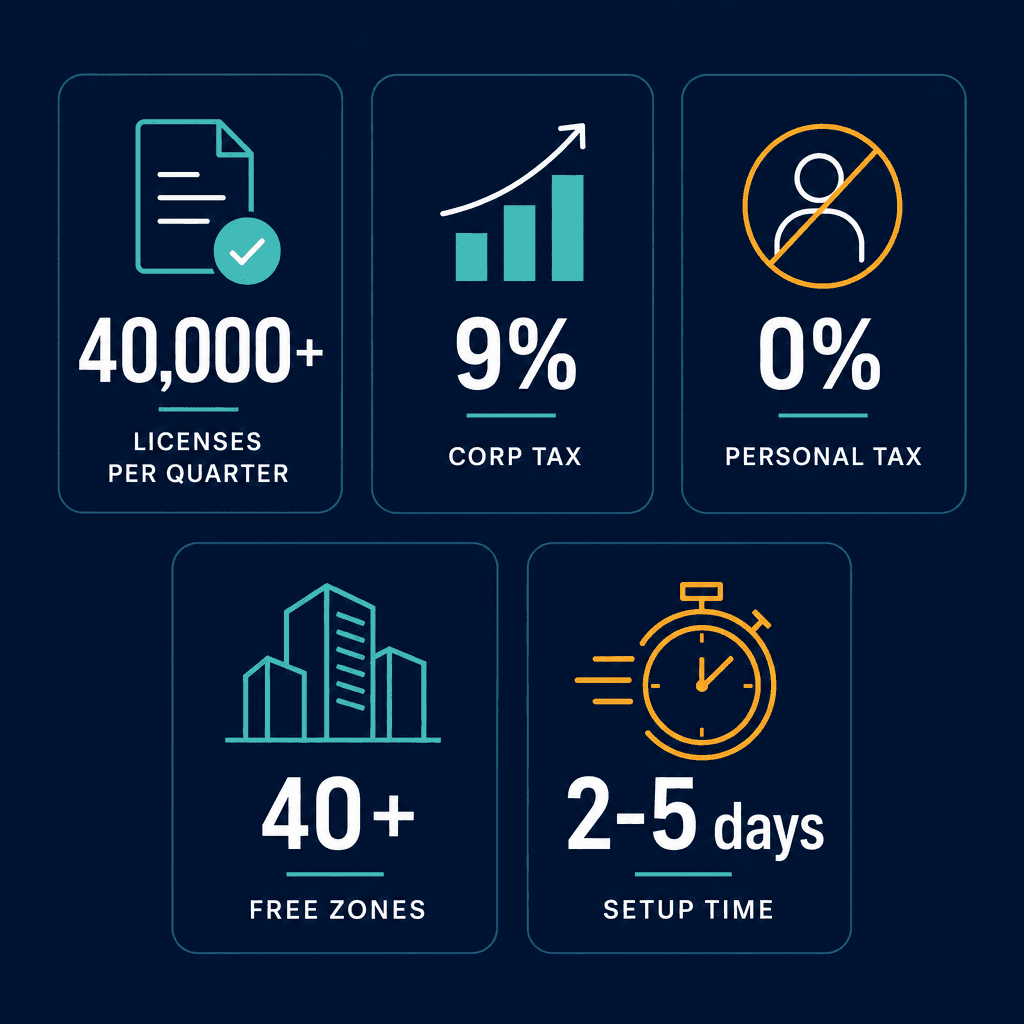
Dubai offers 0% personal income tax, 100% foreign ownership in free zones and now most mainland sectors, fast incorporation timelines as short as 2 to 5 business days, and a strategic location between Europe, Asia, and Africa, making it one of the most founder-friendly jurisdictions in the world in 2025. If you're starting a new business in Dubai, the structural advantages are real and measurable, not just marketing copy.
The Numbers That Make Dubai Compelling for International Founders
0% personal income tax, no tax on salary, dividends, or personal profit withdrawals (UAE Federal Tax Authority, 2023)
9% corporate tax only on net profits exceeding AED 375,000 (~$102,000 USD), profits below that threshold remain untaxed (UAE Federal Tax Authority, 2023)
40+ free zones across the UAE, each offering 100% foreign ownership and full profit repatriation (UAE Free Zones Council, 2025)
2 to 5 business day incorporation timelines in leading free zones
UAE ranked 16th globally for ease of doing business in the World Bank's most recent assessment (World Bank, 2024)
Here's what that means in practice. A US-based e-commerce founder who sets up a new business in Dubai through a free zone pays zero personal income tax on profits and can hold a USD-denominated bank account. Compare that to a Delaware LLC generating the same revenue, subject to federal income tax, state taxes, and self-employment levies. The structural difference is significant, not marginal.
What Changed in 2023 to 2025 That Makes This the Right Moment
Before 2023, a foreign founder setting up a Dubai mainland trading company needed a UAE national to hold 51% of shares. Federal Decree-Law No. 26 of 2020, fully operationalised through the 2023 amendment to the UAE Commercial Companies Law, removed that requirement for most commercial activities. You can now own 100% of a mainland company outright, a structural shift that changes the risk calculation entirely.
The introduction of UAE Corporate Tax in June 2023 actually brought clarity rather than burden for most SMEs. If your annual profits stay below AED 375,000, your effective tax rate is zero. For the majority of early-stage founders, that's not a constraint, it's a green light. For a deeper look at the full incorporation process, the guide to company formation in Dubai covers each step in detail.
What Is a Trade License and Why It's the Foundation of Your Dubai Business
A trade license is the government-issued permit that legally authorises your business to operate in Dubai. Issued by a free zone authority or the Department of Economic Development (DED), it specifies your permitted business activities, your company name, and your legal structure. Without it, you cannot open a business bank account, hire staff, or sign commercial contracts. When you set up a new business in Dubai, the trade license is the first document everything else depends on.
The Three Main License Types and Which One Fits Your Business
Commercial license: for trading, import/export, distribution, and general merchandise businesses
Professional license: for service-based businesses, consultants, designers, coaches, marketing agencies, freelancers
Industrial license: for manufacturing, production, assembly, and processing operations
Sector-specific licenses also exist. Several free zones issue dedicated permits for media, technology, healthcare, and education, with activity lists tailored to those industries. A US marketing consultant setting up in Dubai would apply for a professional license listing "management consultancy" and "marketing consultancy" as permitted activities. A commercial license, reserved for goods trading, would be the wrong category entirely and could create compliance problems down the line.
How Business Activities Work and Why Choosing the Right Ones Matters
Every trade license lists specific permitted activities, you can only legally invoice for activities on your license
Activities are drawn from a standardised government list; some free zones allow 3 to 5 activities per license, others allow unlimited
Activity descriptions broadly align with ISIC Rev.4 international classification codes, precision in your wording matters
Amending activities post-incorporation typically costs AED 500 to AED 2,000 depending on the authority
A SaaS founder who lists only "software development" on their license cannot legally invoice clients for "IT consultancy", that's a separate, distinct activity under UAE law. Get your activity list right before you apply, not after. For new business setup Dubai guidance on activity selection, check the guide to company formation in Dubai.
Free Zone vs. Mainland vs. Offshore: The Decision That Shapes Everything
Free zones offer 100% foreign ownership and fast setup but restrict direct trading in the UAE local market. Mainland companies can trade anywhere in the UAE and internationally. Offshore structures are for asset holding and international operations only, with no UAE residency visa eligibility. Your target customers and operational model determine the right choice when you decide how to set up a business in Dubai.
Free Zone vs. Mainland vs. Offshore: Which Structure Fits Your Business?
Feature | Free Zone | Mainland | Offshore |
|---|---|---|---|
Foreign Ownership | ✅ 100% guaranteed | ✅ 100% (post-2023, most activities) | ✅ 100% guaranteed |
UAE Market Access | ❌ Restricted, needs distributor for mainland sales | ✅ Unrestricted, sell to any UAE customer | ❌ No UAE market access permitted |
Setup Speed | ✅ 2–5 business days | ⚠️ 1–3 weeks (DED process) | ✅ 3–7 business days |
Typical First-Year Cost | AED 15,000–35,000 (1-visa package) | AED 15,000–50,000+ depending on activity | AED 10,000–20,000 (no visa included) |
Visa Eligibility | ✅ Investor visa available | ✅ Investor visa available | ❌ No UAE residency visa |
Best For | International trade, remote services, e-commerce, consultants | Retail, F&B, government contracts, UAE-facing businesses | Asset holding, international IP structures, no UAE operations |
Free Zones: Best for International Business, Remote Services, and Founders Who Want Speed
100% foreign ownership, no UAE national partner required
0% import/export duties within the free zone perimeter
Incorporation in 2 to 5 business days at most authorities
Cannot sell directly to UAE mainland customers without a local distributor or a separate mainland entity
40+ free zones to choose from, each with distinct sector specialisations
Dubai South Business Hub Free Zone sits adjacent to Al Maktoum International Airport, making it a natural fit for logistics, e-commerce, and aviation-adjacent businesses that need fast setup and a credible Dubai address. For a full breakdown of how free zone and mainland structures compare, the free zone vs mainland business setup guide covers the trade-offs in detail.
Mainland: Best If You're Selling to UAE Consumers or Government
Can trade directly with any UAE mainland customer, no restrictions
Required for most government tenders and retail-facing businesses
100% foreign ownership available for most activities post-2023 amendment (UAE Ministry of Economy, 2023)
Licensed by the DED, process is more document-intensive than free zone setup
Setup costs typically range AED 15,000 to AED 50,000+ depending on activity and office requirement
A restaurant group or retail chain targeting UAE consumers must incorporate on the mainland. A free zone license alone won't legally permit walk-in sales to the general public. That's the clearest test: if your customers are physically in the UAE, mainland is almost always the right structure to start a new company in the UAE.
Choosing the Right Free Zone or Mainland Authority for Your New Business
Choose your jurisdiction based on your business activity, target market, visa requirements, and budget, not just on price. Free zones like Dubai South, DMCC, IFZA, and DIFC each attract different sectors. Mainland is regulated by the DED. The wrong jurisdiction can limit your activities or cost more to fix than it saved to set up when you're trying to set up a new business in Dubai.
How to Match Your Industry to the Right Free Zone
DMCC (Jumeirah Lakes Towers): commodities, trading, crypto, fintech, hosts over 22,000 member companies (DMCC, 2024)
DIFC (Dubai International Financial Centre): financial services, legal, wealth management, operates under English common law with its own court system
Dubai Internet City / Dubai Media City: technology, media, marketing, strong talent ecosystem and co-working infrastructure
Dubai South Business Hub Free Zone: logistics, e-commerce, aviation, general trading, strategic position near Al Maktoum International Airport
IFZA (International Free Zone Authority): popular all-rounder for SMEs, consultants, and international founders, competitive pricing across packages
A UK-based commodities trader relocating operations to the UAE would typically choose DMCC, which has dedicated infrastructure for metals, energy, and agricultural trading. For logistics and e-commerce founders, launching your company at Dubai South Business Hub Free Zone puts you minutes from one of the world's fastest-growing cargo hubs.
The Cost Variables That Change Depending on Your Jurisdiction
License fee: AED 5,000 to AED 25,000+ depending on free zone and activity type
Visa allocation: each license has a quota, confirm the number of visas included before signing
Office requirement: flexi-desk, virtual office, or physical office carry significantly different annual costs
Government fees: establishment card and immigration card add AED 2,000 to AED 5,000 to most packages
Two founders comparing IFZA and a premium free zone for a consulting business found an AED 12,000 annual difference, entirely driven by the office tier requirement, not the license fee itself. First-year total cost is often 30 to 40% higher than the headline license fee. Use the cost calculator to build an accurate first-year budget before committing.
Visa and Residency Options When You Set Up a New Business in Dubai
Incorporating a UAE company entitles the founder to apply for a UAE investor or partner visa, which grants 2 to 3 year renewable residency. This gives you a UAE Emirates ID, access to a local bank account, and the ability to sponsor family members. Visa eligibility and quota depend on your license type, free zone, and chosen package, so it's worth confirming before you set up a new business in Dubai.
Investor Visa vs. Employment Visa: What Each One Gets You
Investor/partner visa: issued to company shareholders, renewable every 2 to 3 years, tied to the company's active status
Employment visa: issued to staff hired under the company, requires a Ministry of Human Resources and Emiratisation (MOHRE) quota allocation
Golden Visa (10-year): available to investors meeting the AED 2 million property or business investment threshold (UAE GDRFA, 2024)
Freelance/professional visa: available through select free zones for solo practitioners who don't need a full company structure
A Canadian founder setting up a consulting company in Dubai would typically apply for a 3-year investor visa linked to their free zone license. That visa grants UAE residency, an Emirates ID (issued within 5 to 7 business days of visa stamping), and the ability to open a personal UAE bank account. It's the practical foundation for operating as a resident founder, not just a registered company.
Can You Set Up a Dubai Company Without Living There?
Yes, and many founders do exactly that. Most UAE free zones allow full remote incorporation. You don't need to be physically present to submit documents, pay fees, or receive your trade license. The visa application is a different matter: it requires a UAE entry, a medical test, and biometric registration. But that entire process can be completed in a single visit of 3 to 5 days.
Banking is the one step that most consistently requires in-person presence. Some challenger banks now offer remote onboarding for non-residents, but traditional UAE banks still expect a branch visit. Several founders based in the United States have incorporated their Dubai free zone company entirely remotely, flying in once for visa stamping and bank account opening. It's genuinely manageable. Read the full guide to company formation in Dubai for a step-by-step breakdown of the remote incorporation process.
Is the UAE Golden Visa worth it for new business founders?
For most early-stage founders, the standard investor visa is the right starting point. The Golden Visa (10-year) requires an AED 2 million investment threshold and a more complex application process. It's best suited to founders who have already established UAE operations and want long-term residency security, not those setting up for the first time (UAE GDRFA, 2024).
Banking, Costs, and the Financial Realities of a New Business Setup in Dubai
Opening a UAE business bank account requires your trade license, Emirates ID, company documents, and a business plan. Minimum balance requirements range from AED 0 to AED 50,000+ depending on the bank. First-year total setup costs for a free zone company typically fall between AED 15,000 and AED 35,000 for a single-visa package. Knowing these numbers upfront is part of how to set up a business in Dubai without surprises.
What UAE Banks Actually Ask For, and How to Prepare
Core documents: trade license, certificate of incorporation, memorandum of association, passport copies, Emirates ID, proof of address
Business plan: most banks require projected transactions for 6 to 12 months
Compliance scrutiny: founders with complex ownership structures or passports from higher-risk jurisdictions face longer onboarding timelines
Digital alternatives: challenger banks like Wio and Mashreq Neo offer faster SME onboarding with lower minimum balance requirements
Timelines: traditional banks take 2 to 6 weeks; digital-first banks typically complete onboarding in 3 to 7 days
A US founder with a straightforward consulting company and clean transaction history opened a Wio business account in under a week. The same founder's application at a major retail bank took four weeks and required an in-person branch visit. If speed matters, start with a digital bank and add a traditional account later as your
References
Editorial sources available on request. Full citation list is being compiled.