

Transferring from mainland to free zone in Dubai is a redomiciliation, not an amendment — in practice it usually means forming a new free zone entity and winding down the mainland one. The driver is usually cost: local agent fees run AED 10,000 to AED 25,000 per year, which a free zone entity does not incur at all.
Over 40% of UAE mainland business owners who reassess their setup after year one identify free zone redomiciliation as a cost-saving opportunity, yet most don't realise the move is entirely possible. The full transition runs 6-12 weeks.
If you set up on the UAE mainland and are now questioning whether a free zone would have been the better choice, lower overheads, simpler compliance, 100% foreign ownership without a local agent arrangement, this guide walks you through exactly how to transfer mainland to free zone Dubai. You'll find both pathways explained, what each costs, and what to plan for before you make the move.
What Redomiciliation Means When You Transfer Mainland to Free Zone Dubai
Redomiciliation in the UAE means legally migrating your company's registered jurisdiction from a mainland authority to a free zone authority. The business entity is re-registered under free zone law, retaining its history where possible. In practice, most owners close the mainland license and open a new free zone company instead, a simpler, faster route. There are two distinct pathways, and choosing the right one depends on what your existing entity carries.
Formal Redomiciliation: The Legal Migration Route
Formal redomiciliation transfers the legal entity itself, shareholders, history, contracts, from mainland jurisdiction to a free zone under UAE Federal Law No. 32 of 2021 on Commercial Companies, which formally introduced the redomiciliation mechanism for the first time. This is the route that preserves entity continuity. But it's not simple.
To redomicile mainland free zone Dubai via the formal route, you need approval from both the originating mainland authority (the Department of Economy and Tourism, or the relevant emirate department) and the destination free zone authority. Not all free zones accept inbound redomiciliation, that's a critical point to verify early. Processing timelines typically run 3-6 months, and the paperwork burden is substantially higher than a fresh incorporation.
This pathway suits companies with:
Complex multi-tier shareholding structures
Existing bank facilities tied to the mainland entity's credit history
Long-term contracts where novation to a new entity would be commercially disruptive
Financing arrangements where the lender requires entity continuity
A trading company with a five-year financing arrangement from Emirates NBD tied to its mainland LLC entity, for example, may opt for formal redomiciliation to preserve the facility rather than triggering a full new credit application under a fresh entity.
Close-and-Reopen: The More Common Pathway
The majority of business owners who change from mainland to free zone Dubai take a different route entirely: cancel the mainland license and incorporate a new free zone entity. It's faster, cheaper, and administratively cleaner. The new company is a fresh legal entity with a new trade license, new bank account, and its own visa quota.
The trade-off is that existing contracts must be novated or re-signed, and employee visas must be cancelled and reissued under the new entity. That's manageable with good planning. A Dubai-based e-commerce consultancy with two partners and no third-party financing chose this route at Dubai South Business Hub Free Zone, completing the new incorporation in four business days and novating three client contracts within the same month.
For most small to mid-size businesses, this is the right call. It's worth reading our guide on free zone vs mainland business setup Dubai before deciding which free zone to target.
Redomiciliation vs. Close-and-Reopen: Which Pathway Fits Your Business
Formal redomiciliation preserves your legal entity and is best when contracts or financing are tied to the existing company. The close-and-reopen pathway, cancelling your mainland license and forming a new free zone company, is faster, less expensive, and suits most small to mid-size businesses switching business structure in the UAE. Here's how the two compare side by side.
Formal Redomiciliation vs. Close-and-Reopen: At a Glance
Feature | Formal Redomiciliation | Close-and-Reopen |
|---|---|---|
Legal Entity | ‚úÖ Same entity preserved | ‚ùå New entity created |
Typical Timeline | 3-6 months | 6-12 weeks |
Estimated Cost (Govt + Free Zone Fees) | AED 20,000-40,000+ | AED 12,000-25,000 |
Existing Contracts | ‚úÖ Transfer with entity | ‚ùå Must novate each contract |
Banking Continuity | ‚úÖ Facilities may transfer | ‚ùå Full KYC re-application |
Free Zone Compatibility | Limited, not all free zones accept inbound | ‚úÖ Any free zone works |
Best For | Complex shareholding, active financing | Most SMEs, professional services, consultancies |
When Formal Redomiciliation Makes Financial Sense
That's a significant outlay, so it needs to be justified. The scenarios where it makes sense are specific:
Active bank facilities or letters of credit tied to the mainland entity's credit history
Long-term government or enterprise contracts where counterparty consent to novation is difficult to obtain
Complex multi-tier shareholding where re-establishing ownership in a new entity triggers additional regulatory filings or tax disclosures in the owners' home countries
Situations where losing the entity's operational history creates a demonstrable commercial disadvantage
A logistics firm holding a five-year exclusive distribution agreement with a European supplier, where the contract explicitly prohibits assignment without written consent, found formal redomiciliation far less disruptive than renegotiating the agreement from scratch.
Why Most Owners Choose the Close-and-Reopen Route
And the new entity starts clean: no inherited compliance gaps, no legacy disputes, no deferred liabilities. You get immediate access to free zone benefits, 0% corporate tax on qualifying income under the UAE Corporate Tax Law (UAE Ministry of Finance, 2023), 100% foreign ownership, and no currency restrictions.
A two-person marketing agency on the Dubai mainland with no external financing and month-to-month client retainers completed the close-and-reopen route in under three weeks total, including mainland cancellation and free zone incorporation. That's the typical experience for well-prepared applicants. Check our Dubai free zones guide for startups to shortlist your destination.
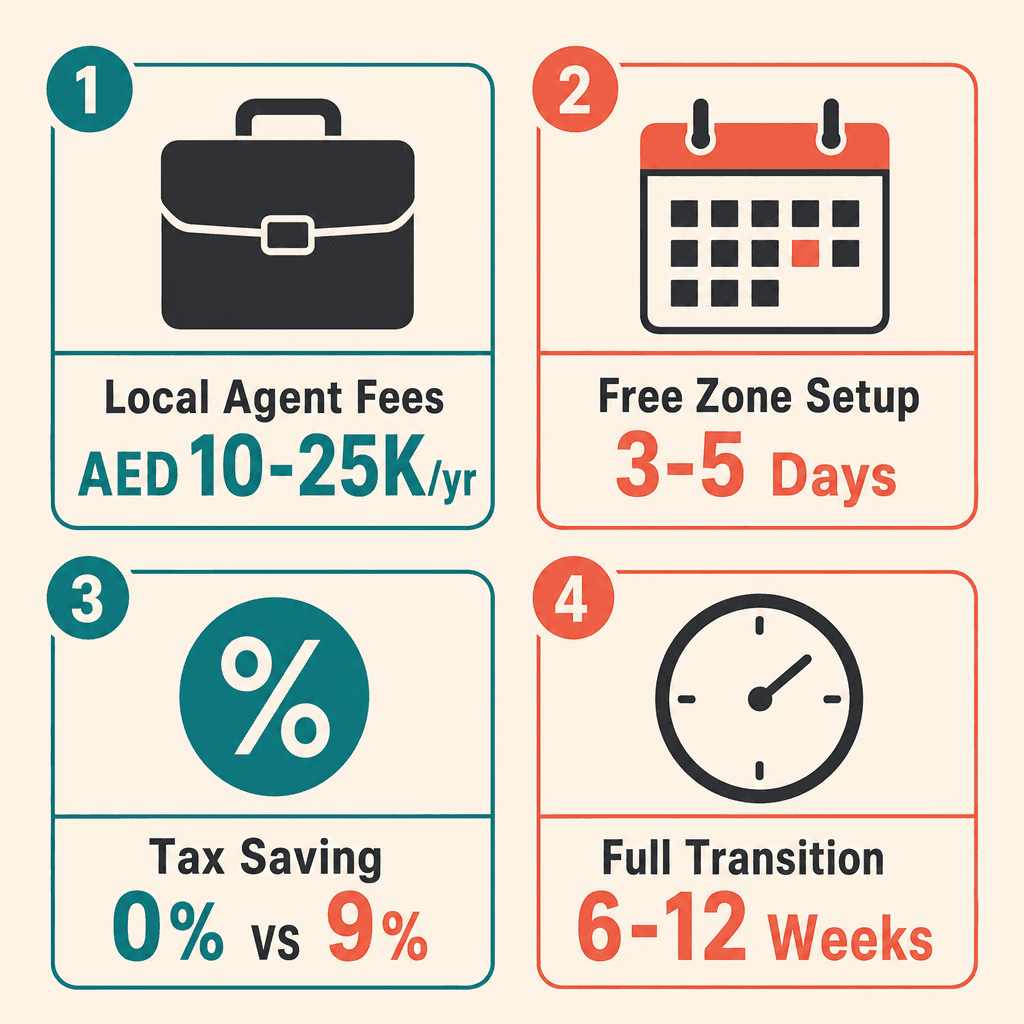
UAE Mainland-to-Free Zone Transfer: Key Numbers at a Glance
A quick-reference visual summarising the core costs, timelines, and savings for business owners considering the switch.
Close-and-reopen total cost: AED 12,000-25,000
Formal redomiciliation cost: AED 20,000-40,000+
Free zone incorporation timeline: 3-5 business days (Dubai South Business Hub)
Full transition timeline: 6-12 weeks (close-and-reopen)
Annual local agent fee eliminated: AED 10,000-25,000
Corporate tax on qualifying free zone income: 0% vs 9% on mainland
Suggested alt text: Infographic comparing costs, timelines, and tax savings for transferring a company from UAE mainland to a free zone in 2026.
Key Considerations Before You Move Company from Mainland to Free Zone UAE
Before you move a company from mainland to free zone UAE, audit four areas: active contracts that need novation, banking relationships that may require new account applications, employee visas that must be cancelled and reissued, and whether your licensed activity can actually be replicated inside a free zone, not all regulated activities can. Skipping this audit is the single most common cause of delays and unexpected costs.
Contracts, Client Agreements, and Novation Obligations
Every active contract referencing your mainland entity's trade license number or legal name needs to be novated to the new free zone entity.
Client retainer agreements are typically the easiest to novate. Multi-party JV agreements and financing documents are the hardest. A practical tip: draft a standard novation letter template early and approach key clients before the mainland license is cancelled. A Dubai-based HR consultancy with 12 active client retainers prepared novation letters four weeks before cancelling its mainland license, securing sign-off from 11 of 12 clients before the switch completed.
Banking Relationships and the New Account Reality
UAE banks treat a new free zone entity as a new customer. The mainland account does not transfer, and you'll go through full KYC and account opening again.
Plan for a transition period where both accounts are active simultaneously. That's critical for payroll continuity. Some free zones have preferred banking partners that can accelerate the process; Dubai South Business Hub has relationships worth enquiring about directly.
Warning: A tech startup that rushed its mainland cancellation before the free zone bank account was confirmed experienced a three-week payroll delay. That's entirely preventable with correct sequencing, bank account first, mainland cancellation second.
Employee Visas and the Cancellation-Reissue Process
Visas sponsored by the mainland entity must be cancelled and reissued under the new free zone entity. Employees cannot simply transfer sponsorship between entities. Employees have a 30-day grace period after visa cancellation before they must leave the UAE or have a new visa in process (UAE GDRFA rules, still accurate as of 2026).
If you have a larger team, manage the transition in tranches. A 10-person agency that split its team into two groups of five avoided a scenario where half its staff were simultaneously in visa grace period, operations continued without disruption throughout. Confirm your headcount needs before selecting a license package. See our guide on company formation in Dubai step by step for a fuller breakdown.
6 stepsh2>
To transfer mainland to free zone Dubai via the close-and-reopen route: audit your existing obligations, choose your free zone and activity, incorporate the new free zone entity, open a business bank account, novate contracts and transfer employees, then cancel the mainland license. Allow 6-12 weeks for the full transition from start to finish.
A process timeline showing the six steps to move a company from UAE mainland to a free zone, from pre-move audit through to mainland license cancellation. 6 Steps to Transfer Mainland to Free Zone Dubai 1Pre-MoveAudit 2ChooseFree Zone 3IncorporateNew Entity 4Open BankAccount 5NovateContracts 6CancelMainland Lic.
Six-step close-and-reopen pathway for transferring from UAE mainland to a free zone. Typical full timeline: 6-12 weeks (Dubai South Business Hub Free Zone, 2024).
Steps 1-3: Preparation and New Entity Formation
Pre-move audit: List all active contracts, banking facilities, employee visas, and regulatory licenses tied to the mainland entity. Identify anything that cannot be replicated in a free zone, regulated activities are covered in the section below.
Select your destination free zone: Confirm your licensed activity is available on the free zone's approved activity list. Check visa quota options and office or flexi-desk requirements. Use the free zone vs mainland business setup Dubai guide to shortlist candidates.
Incorporate the new free zone company: Submit your Memorandum of Association, shareholder passport copies, business plan (if required), and license application. At Dubai South Business Hub Free Zone, incorporation can complete in 3-5 business days.
A management consultancy owner used the Dubai South Business Hub Free Zone online application portal, uploaded documents digitally, and received provisional approval within 48 hours, with the physical license issued on day four. That's the kind of speed that makes the change from mainland to free zone Dubai genuinely practical.
Steps 4-6: Banking, Novation, and Mainland Cancellation
Open a business bank account: Do this before cancelling the mainland license. Maintain parallel accounts during the transition window. This is the sequencing step most people get wrong.
Novate contracts and transfer employee visas: Send novation letters to clients and suppliers. Cancel and reissue employee visas under the new entity. Update supplier and government portal registrations to reflect the new license details.
Cancel the mainland license: Settle all outstanding DET fees, obtain a no-objection letter if required, and submit the cancellation application. You'll need clearance from immigration, labour, and tax authorities before formal cancellation is issued.
A Dubai South client completing this process in 2024 maintained a six-week overlap between mainland and free zone entities, paying both licenses for one renewal cycle, to ensure zero disruption to client billing and employee payroll. That overlap cost was more than offset by the savings in the first full free zone year. Ready to get started? Launch your company at Dubai South Business Hub Free Zone or calculate your free zone setup cost first.
How long does it take to transfer a company from mainland to free zone in Dubai?
The close-and-reopen pathway takes 6-12 weeks from start to finish. Free zone incorporation completes in 3-5 business days at Dubai South Business Hub. Mainland cancellation takes 2-4 weeks once all clearances are obtained. Bank account opening adds 4-8 weeks running in parallel, so start it early.
Costs and Timelines for Moving from Mainland to Free Zone UAE
The close-and-reopen pathway typically costs AED 12,000-25,000 for free zone incorporation plus AED 3,000-8,000 to cancel the mainland license, with visa costs added per employee. Total transition time runs 6-12 weeks. Formal redomiciliation costs more, AED 20,000-40,000 in fees, and takes 3-6 months. When you move company from mainland to free zone UAE, the cost picture is almost always better than staying put.
What to Budget for the Close-and-Reopen Route
Here's a realistic line-item breakdown:
Free zone trade license + establishment card:
Flexi-desk or office package:
Mainland license cancellation fees: AED 1,000-3,000 in government fees plus any outstanding renewal arrears
Employee visa cancellation and reissue:
Legal and advisory fees for novation and contract review: AED 3,000-10,000 depending on contract complexity
A sole-owner consultancy moving to Dubai South Business Hub Free Zone budgeted AED 18,000 total for the first year, covering license, flexi-desk, one visa, and mainland cancellation, saving approximately AED 22,000 compared to its mainland renewal cost with local agent fees.
Planning Your Transition Budget Carefully
When you move company from mainland to free zone UAE, the biggest hidden cost is the overlap period. Plan to carry both licenses for at least four to six